Impact of Special Needs
  • BLOG 2017
  • IMPACT
    • History of Special Education Christina Pressley
    • INQUIRY >
      • RESEARCH AVENUES >
        • Marshall Memo
    • SYLLABUS >
      • Norms
      • Council for Exceptional Children
      • Flight Practice
      • Ladder of Feedback
      • Marshmallow Challenge
      • MeMoves!
      • National Teaching Norms
      • Scavenger Hunt
      • Unthinkables
  • FOUNDATIONS
    • Common Core >
      • Mathematics >
        • Math Graphic Organizers
        • Math: Subitizing and Ten Frames
        • Math Inclusion Resources and Strategies
      • Literacy >
        • Alphabet Awareness
        • Classroom Labels
        • Close Reading Strategies
        • The Daily Five
        • Dialogic and Guided Reading
        • Phonics Instruction
        • Phonological Awareness
        • Story Grammar Markers
        • Writing
      • TECHNOLOGY RESOURCES FOR LEARNING >
        • ACCESSIBLE INSTRUCTIONAL MATERIALS
        • Assistive Technology >
          • Assistive Technology Andrew
        • The Flipped Classroom in SPED
        • Science >
          • STEM
        • WEBSITES FOR LEARNING >
          • Web 2.0
          • cool tools
    • IEP >
      • Assessment
      • Terminology
      • Accommodations >
        • Assistive Technology >
          • Technology
          • AIM
        • MCAS Accommodations
      • Documents
      • Goals and Objectives
      • Transition Services >
        • Early Childhood Transition
      • Early Intervention
      • 504 Plans
    • INCLUSION >
      • Child Study Teams >
        • CST Report (Action Plans)
      • DCAP
      • RTI >
        • RTI in SLD Determination Lauren A
        • MA Tiered System of Supports
      • Observations
      • PALS: PEER ASSISTED LEARNING STRATEGIES
      • Para Educator
    • DISABILITY AWARENESS >
      • IRIS Resources STAR Legacy Modules
    • EDUCATIONAL STANDARDS >
      • 21st Century Skills
      • Common Core
      • IDEA >
        • Dear Colleague
        • ADA Americans with Disability Act
      • Special Education History >
        • Timelines in Special Education
    • FAMILY >
      • DIVERSITY
      • ADA and ADULTHOOD
      • Stigma in Special Needs in Latino Family Emily Burdick
  • TOPICS
    • Transgender Youth
  • LEARNING THEORIES
    • LEARNING THEORIES A-G >
      • ABA Jenna
      • All Kinds of Minds
      • Bloom's Taxonomy
      • Behaviorism
      • Bronfenbrenner’s Theory
      • Child Development
      • Cognitivism
      • Constructivism
      • GRIT
      • Growth Mindset
    • LEARNING THEORIES H-Z >
      • Kinesthetic Learning Eilish Reynolds
      • Learning Styles
      • Meaning Making
      • Motivation
      • Neuroscience
      • Building Relationships Katherine Bonilla
      • Social Learning Theory
      • Teaching for Understanding
      • Thinking Maps
      • UDL >
        • Assistive Technolog Jacqueline
        • UDL and the Common Core
        • UDL-Jenny/Lauren
      • Visible Thinking
  • DISABILITIES
    • AUTISM (ASD) >
      • Autism >
        • Autism Family Info Lindsey Blackman
        • Pink on the Spectrum Sara Cane
        • Autism Troy Sargent >
          • Autism and ABA Haley Award
          • Autism Janine Steinhauser
          • Autism James McDonough
        • Autism Rebecca Siegel
        • Autism and Language
        • Autism Kat
        • Autism and Adulthood
        • Autism in an Inclusive Classroom Kathryn N
        • Autism Dana Moody
        • Autism Non-Verbal Justin
      • ASD Resources
      • Autism-Nicky >
        • ABA in Autism Intervention Lauren C
      • Asperger's Syndrome Leeanne
    • COMMUNICATION >
      • Apraxia Victoria >
        • Apraxia Gabrielle D'Avolio
      • Communication Resources >
        • Expressive Language-Chelsey
      • Select Mutism
    • DEVELOPMENTAL DELAY >
      • Fine and Gross Motor Devel.-Denise >
        • Motor Articles
    • EMOTIONAL (BEHAVIOR) >
      • Bipolar Disorder Cailey >
        • Bipolar Disorder Caitlin Worthen
      • Behavior Resources
      • Mental Health Needs in College Peter Rakes
      • Relational Aggression Meghan Lederhos
      • Emotional Apps Katherine Bonilla
      • Trauma Supportive Practice Samantha Sinotte
    • HEALTH >
      • Cancer
      • ADHD and ADD >
        • ADHD Isabella Delmoral
        • ADHD Julia
        • ADHD Olivia Pizzi
        • ADD/ADHD >
          • ADHD Jenny/Lauren
          • ADHD Sarah Morgenthaler
      • Health Resources
    • INTELLECTUAL >
      • Acquired Brain Injury >
        • Intellectual Resources
      • Down Syndrome
      • Down Syndrome Jennifer Whitman
      • Prader-Willi Syndrome Samantha Curtis
    • NEUROLOGICAL >
      • Brain Development-Kate
      • Memory-Sarita
      • EXECUTIVE FUNTIONING >
        • Executive Functioning Disorder Laura Brady
      • Rett Syndrom Brycelyn
      • SENSORY PROCESSING DYSREGULATION >
        • SI Resources >
          • Sensory Integration-Steph >
            • SI Reference Articles
      • Fetal Alcohol Syndrome-Mary >
        • Fetal Alcohol Syndrome Elizabeth Watts
    • PHYSICAL >
      • Hearing Disability Rachel Jones
      • Physical Resources
      • Student Integration After Hospitalization Kathryn R
    • SENSORY >
      • HEARING >
        • Hearing Loss Yan Li Xu
        • Hearing Impairment Brianne Syring
        • Hearing Resources
        • Deaf and Hard of Hearing Brianna Normile
      • Sensory Processing Disorder Mikaela Newell
      • VISION >
        • Vision Resources
    • SPECIFIC LEARNING >
      • SLD Elizabeth Mossop
      • NVLD Nicole Snyder
      • LD Resources >
        • Dyscalculia Lily Chase-Lubitz
        • Dysgraphia Erin Bruce
        • Reading >
          • Dyslexia-Anthony >
            • Dyslexia Lily Montagna
            • Dyslexia Victoria Small
            • Dyslexia 2 Tiffany
            • Dyslexia Meghan
            • Dyslexia Colleen Talbot
          • Early Literacy Resources
          • LD and IDEA Issue
          • Reading by the Rules
        • Content
        • Math
        • Writing
        • Technology >
          • Reading Comprehension Strategies Meredith Chen
        • Teaching
    • TWICE EXCEPTIONAL >
      • Twice Exceptional Articles
      • Twice Exceptional Students Kelcy West
      • Twice Exceptional-Melissa
  • BEHAVIOR
    • CLASSROOM MANAGEMENT >
      • A-J >
        • 21st Century Learning
        • Behavior Modification >
          • Behavior Management Jon Weinberger
        • Bloom's Taxonomy
        • Circle of Friends
        • Collaborative Problem Solving
        • Culturally Responsive Pedagogy
        • The Daily Five
        • Differentiated Instruction
      • K-Z >
        • Kids and War
        • MeMoves!
        • Responsive Classroom
        • Socia Skills Curriculums Jessica Fox
        • Social & Emotional Learning Carol Yourman
        • Social Thinking
        • Strategies for Aggression-Jim
        • Universal Design for Learning
    • PREVENTING BULLYING >
      • Good Play Project
  • PROJECTS 2018
    • INQUIRY >
      • A-K
      • L-Z


EXECUTIVE FUNCTIONING

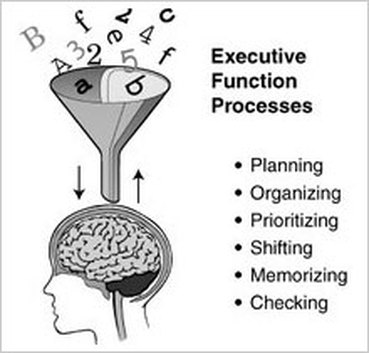
Academic success in our 21st century schools is increasingly linked with children’s mastery of a wide range of skills that rely on their use of executive function strategies. The crucial role of executive function processes begins in the preschool years and increases as students progress through middle and high school when they are expected to master complex skills that involve summarizing, note-taking and writing. Success depends on students’ ability to plan, organize and prioritize tasks, materials, and information, separate main ideas from details, think flexibly, memorize content and monitor their progress. It is important to help children to understand how they think and learn, and to teach them to use strategies in five major executive function areas: 
  • Shifting/Thinking flexibly
  • Organizing
  • Prioritizing
  • Accessing working memory
  • Self-monitoring/Self-checking
Picture
Here are nine key terms and phrases doctors and other professionals use to describe executive functioning skills and the way your child thinks and learns.
  1. CognitionThe many different ways your child’s brain automatically makes sense of things. When experts refer to cognition or to cognitive skills, they mean how your child thinks, knows, remembers, judges and problem-solves.
  2. Emotional controlYour child’s ability to connect what she thinks and knows to how she feels and reacts. Poor emotional control might cause your child to overreact or respond inappropriately to things that upset her. For example, if she loses her video game time because she didn’t finish her chores, she may have a tantrum because her siblings still have their game time.
  3. Flexible thinkingYour child’s ability to think of alternate ways of doing things, integrate new ideas into existing thinking, and abandon what isn’t working to try a new approach. If your child has difficulty seeing other viewpoints or gets stuck on ideas even if they’re not the best plans, experts might describe her as a “rigid thinker.” 
  4. OrganizationThe ways your child gathers and stores information to use in the future. When experts talk about organization, it’s not just about lining things up or putting them away. They’re also referring to how your child stores and manages information in her brain so she can pull it out of her “mental filing cabinet” when she needs to use it. This article was created for Understood.org. Learn more about this new resource.
  5. Self-monitoringYour child’s ability to keep track of her performance on a task, assess how it measures up to a goal, and catch and correct mistakes. Without self-monitoring skills, your child may set the dinner table without noticing that she’s putting the silverware in the wrong place and then be surprised when the table doesn’t look like it should. 
  6. Task initiationYour child’s ability to get started on an activity and come up with ideas or problem-solving strategies on her own. For example, your child may not be able to initiate the task of cleaning her room because she can’t figure out the first thing to do or any of the steps after that.
  7. Working memoryYour child’s ability to hold onto information in order to complete a task or activity. Working memory is a combination of auditory and visual-spatial memory, and relies on attention skills, too. If your child has weak working memory skills, things may “slip her mind” or be “right on the tip of her tongue.”
  8. Visual-spatial working memoryYour child’s ability to use her “mind’s eye” to hold onto visual information long enough to use it. Visual-spatial memory is like a camera in your child’s brain. It can take snapshots to help her do things like search through laundry to find a sock that matches one you’ve shown her. It helps her recall where new things are and where she is in relation to them—for example, finding the bathroom in the middle of the night at a friend’s house without bumping into walls. 
  9. Auditory working memoryYour child’s ability to hold onto information she hears long enough to use it. It’s what helps her remember the five words she just read so she can understand how they fit together in a sentence. It’s also what helps her remember a phone number someone just said to her long enough to dial it.

Picture

"Executive functioning" is a term used to describe the many different cognitive processes that individuals use to control their behavior and to get ready to respond to different situations.
Whether the task at hand is to read a newspaper article, write an e-mail to a friend, have a telephone conversation with a relative or join in a soccer game at the park, executive functioning is at work behind the scenes, helping to accomplish the desired goal.
In other words, executive functioning:
•    Is conscious, purposeful and thoughtful
•    Involves activating, orchestrating, monitoring, evaluating and adapting different strategies to accomplish different tasks
•    Includes an understanding of how people tap their knowledge and skills and how they stay motivated to accomplish their goals
•    Requires the ability to analyze situations, plan and take action, focus and maintain attention and adjust actions as needed to get the job done

Your browser does not support viewing this document. Click here to download the document.
Picture
sarah_ward_execfuncpres.pdf
File Size: 11136 kb
File Type: pdf
Download File

harvard_ef_lecture.pdf
File Size: 9738 kb
File Type: pdf
Download File

executive_functioning_in_the_classroom_by_petrosky.pdf
File Size: 1945 kb
File Type: pdf
Download File

executive_functions.pdf
File Size: 1620 kb
File Type: pdf
Download File

organization_handout.pdf
File Size: 1401 kb
File Type: pdf
Download File

executive_functions_and_learning_presentation.doc
File Size: 86 kb
File Type: doc
Download File

adelaideefnotes_1.pdf
File Size: 765 kb
File Type: pdf
Download File

what_is_executive_functioning.doc
File Size: 57 kb
File Type: doc
Download File

ef-skills-for-educators.pdf
File Size: 7128 kb
File Type: pdf
Download File

execfuncresources.doc
File Size: 34 kb
File Type: doc
Download File

executive_functioning_-_regulating_behavior_for_school_success_-_ncld.org_-_pdf.pdf
File Size: 63 kb
File Type: pdf
Download File

executive_function_weston.pdf
File Size: 5730 kb
File Type: pdf
Download File

2011_session_04_-_ward.pdf
File Size: 4519 kb
File Type: pdf
Download File

ef_lecture_parentshandouts.pdf
File Size: 3433 kb
File Type: pdf
Download File

executive_funtion_development.pdf
File Size: 452 kb
File Type: pdf
Download File

1599-ward-sarah.pdf
File Size: 3897 kb
File Type: pdf
Download File

session43.pdf
File Size: 4136 kb
File Type: pdf
Download File

aut_unit3.3_organization.pdf
File Size: 3037 kb
File Type: pdf
Download File

overview_of_strategies.pdf
File Size: 18 kb
File Type: pdf
Download File

Proudly powered by Weebly