Behavior Management

Behavior management is a struggle for many teachers. In order to manage student behavior, it is important to understand WHY maladapted behaviors exist. On this website, I will share both general concepts about behavior and methods to help manage maladapted behavior.
The first section of my website focuses on the function of behaviors and how to reinforce them. I will go through the four functions of behavior: Attention, Escape/Avoidance, to receive a Tangible reward, and Sensory stimulation. Then I will review a Functional Behavior Analysis (FBA) to understand why a behavior occurs and to identify the function of the behavior. Ways to collect data are reviewed, including ABC charts and frequency charts. Replacement behaviors are discussed as behaviors that meet the functional needs of the maladapted behavior, but in an appropriate way. We will then review reinforcement as something different than punishment. Punishment decreases a behavior, while reinforcement increases a behavior. There are basic rules to using reinforcers, and several of those are shared.
The second section of my website focuses on Behavior Intervention Plans (BIPs) and kinds of differential reinforcement plans. These plans use reinforcement in different ways and include DRO (Other behaviors), DRA (Alternate behaviors), DRI (Incompatible behaviors), DRL (Lower-rates of behavior), and DRH (Higher-rates of behavior) plans. I provide examples of a BIP for a student, Joe. In this section I connect behavior plans to PBIS and RtI. I will also discuss how to fade a student off of a behavior plan.
The third section of my website focuses on working with students with autism and anxiety.
The final section provides other tools for behavior management, including extinction, modeling, and providing clear expectations.
The first section of my website focuses on the function of behaviors and how to reinforce them. I will go through the four functions of behavior: Attention, Escape/Avoidance, to receive a Tangible reward, and Sensory stimulation. Then I will review a Functional Behavior Analysis (FBA) to understand why a behavior occurs and to identify the function of the behavior. Ways to collect data are reviewed, including ABC charts and frequency charts. Replacement behaviors are discussed as behaviors that meet the functional needs of the maladapted behavior, but in an appropriate way. We will then review reinforcement as something different than punishment. Punishment decreases a behavior, while reinforcement increases a behavior. There are basic rules to using reinforcers, and several of those are shared.
The second section of my website focuses on Behavior Intervention Plans (BIPs) and kinds of differential reinforcement plans. These plans use reinforcement in different ways and include DRO (Other behaviors), DRA (Alternate behaviors), DRI (Incompatible behaviors), DRL (Lower-rates of behavior), and DRH (Higher-rates of behavior) plans. I provide examples of a BIP for a student, Joe. In this section I connect behavior plans to PBIS and RtI. I will also discuss how to fade a student off of a behavior plan.
The third section of my website focuses on working with students with autism and anxiety.
The final section provides other tools for behavior management, including extinction, modeling, and providing clear expectations.
Part 1: Functions of Behavior
There are 4 functions of Behavior: attention, escape/avoidance, tangible reward, and sensory stimulation.
1) Attention - Students will try to gain attention, either from their peers or from adults. This does not have to be positive attention. Negative attention is still attention.
2) Escape/Avoidance - Students will try to avoid a situation that they do not want to be part of. This occurs often in schools, partly because students may want to avoid certain subjects. It is important that the consequence does not take them out of the situation they wanted to avoid or else that will reinforce the maladapted behavior. Before setting consequences in school for these types of behaviors, consider whether or not a student is avoiding the academics because they need to learn something, rather than they just "don't like" a subject.
3) Tangible Reward - Students will try to gain something tangible that they like. This could be candy, a toy, or extra recess. Token economies play into students' desires to gain something tangible.
4) Sensory Stimulation - Students will do something because it feels good. Replacement behaviors must provide the same sensory stimulation, but in an appropriate way.
1) Attention - Students will try to gain attention, either from their peers or from adults. This does not have to be positive attention. Negative attention is still attention.
2) Escape/Avoidance - Students will try to avoid a situation that they do not want to be part of. This occurs often in schools, partly because students may want to avoid certain subjects. It is important that the consequence does not take them out of the situation they wanted to avoid or else that will reinforce the maladapted behavior. Before setting consequences in school for these types of behaviors, consider whether or not a student is avoiding the academics because they need to learn something, rather than they just "don't like" a subject.
3) Tangible Reward - Students will try to gain something tangible that they like. This could be candy, a toy, or extra recess. Token economies play into students' desires to gain something tangible.
4) Sensory Stimulation - Students will do something because it feels good. Replacement behaviors must provide the same sensory stimulation, but in an appropriate way.
Functional Behavior Assessments
|
A Functional Behavior Assessment (FBA) is a tool used to understand why students behave the way they do. Once the function of a behavior is identified, the team can select the correct interventions: replacement behaviors that fulfill the function of the maladapted behavior, but in an appropriate manner. This is a guide on implementing an FBA.
|
This video provides an in-depth explanation about how to write an FBA. Although this form is for a specific county, the process and information collected does not vary from a typical FBA.
|
Collecting Data
ABC Charts
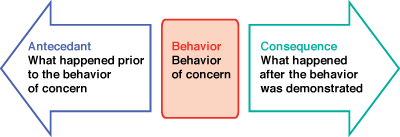
To fully assess a behavior, data must be collected. One way to collect data is to create an ABC chart. This allows a teacher to record the events that occurred BEFORE the behavior occurred (antecedent); the actually BEHAVIOR; and the events that occurred AFTER the behavior occurred (consequence). This can provide an insight into patterns and/or reasons for maladapted behaviors.
|
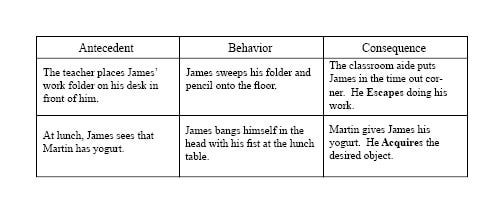
This is an example of an ABC chart. The behaviors of the teacher and student are indicated, as well as how the consequence impacted the function of the behavior.
|
Data Collection Forms
In addition to ABC forms, teachers can collect data at different intervals of time to record how often behaviors occur. This can give insight into the behavior (i.e. - it only occurs on Mondays or the end of the day), as well as the frequency to determine whether an intervention has worked.
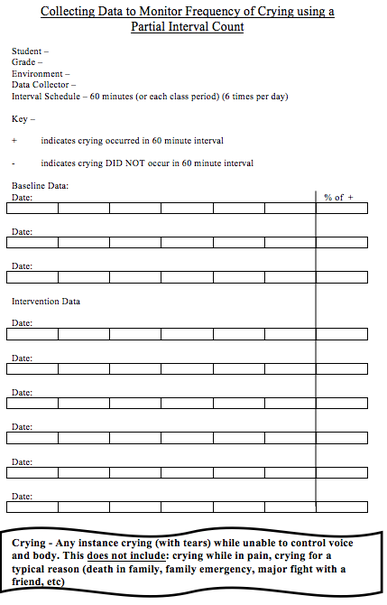
This is an example of a data collection sheet used for a student whose target behavior is crying. Baseline data is important because it shows how often the student displays the behavior before an intervention takes place. The data after the intervention is in place shows the progress of the behavior plan. Notice how the target behavior is defined at the bottom of the page. This definition describes what the behavior looks like, and what is does not look like.
Replacement Behaviors
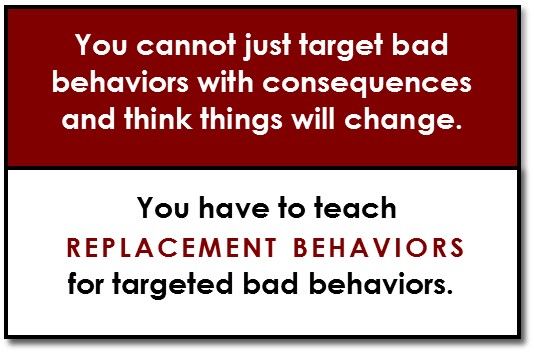
Maladapted behaviors must be replaced with an appropriate replacement behavior. It is extremely important that the replacement behavior meets the functional needs of the maladapted behavior, just in an appropriate way. For example, if a student is calling out in class because they want attention, then a good replacement behavior would give them positive attention when raising their hand. It is a good replacement behavior because the student is getting their functional behavioral needs met (getting attention) while doing so in an appropriate way. Simply yelling at the student for calling out is still giving the behavior attention, and therefore will lead to repeat incidences of that behavior.
Reinforcement - An Overview
|

|
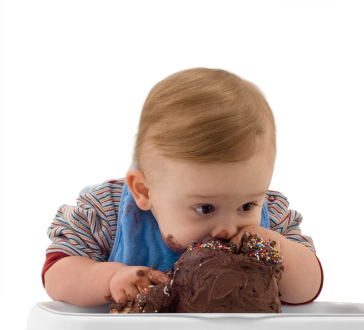
Simply put, a reinforcer is anything that motivates a person
Reinforcement vs. Punishment
A reinforcement is different from a punishment. Reinforcement is used to increase a behavior, while punishment is used to decrease a behavior. Within reinforcement and punishment, there is a distinction between HOW a behavior is increased or decreased, and that is whether or not it is positive (a stimulus is ADDED) or negative (a stimulus is TAKEN AWAY). Here are some examples:
Positive Reinforcement - Praise is ADDED to encourage a behavior to occur (completing a difficult math problem)
Negative Reinforcement - Unpleasant nagging is TAKEN AWAY to encourage a behavior to occur (doing the dishes)
Positive Punishment - Chores are ADDED to discourage a maladapted behavior from occurring (hitting a sibling)
Negative Punishment - Privileges are TAKEN AWAY to discourage a maladapted behavior from occurring (hitting a sibling)
Positive Reinforcement - Praise is ADDED to encourage a behavior to occur (completing a difficult math problem)
Negative Reinforcement - Unpleasant nagging is TAKEN AWAY to encourage a behavior to occur (doing the dishes)
Positive Punishment - Chores are ADDED to discourage a maladapted behavior from occurring (hitting a sibling)
Negative Punishment - Privileges are TAKEN AWAY to discourage a maladapted behavior from occurring (hitting a sibling)
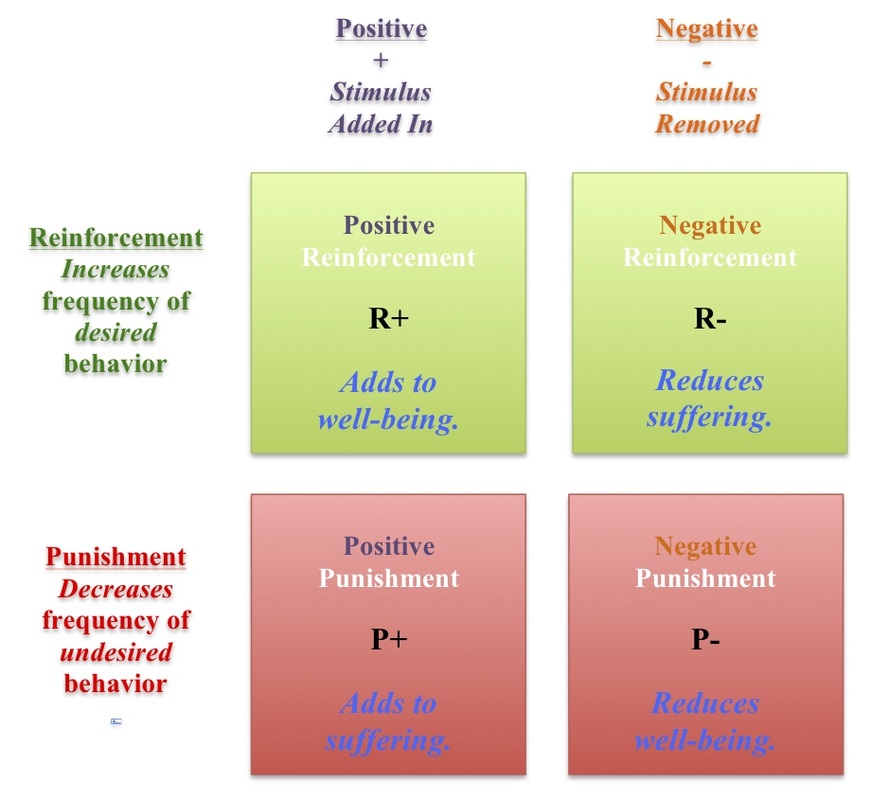
This image shows the differences between punishment and reinforcement, as well as positive or negative versions of both.
Basic Rules of Reinforcement
Rule 1 - Reinforcers should ACTUALLY be reinforcing. - A reinforcer that a child doesn't care about will do nothing to motivate them to change their behavior. Using the Motivation Assessment Scale (MAS) will help in determining reinforcers.
Rule 2 - Reinforcers can stand in place of REAL motivators - If a student's reinforcer is to use the computer, this can not happen IN THE MOMENT during a math lesson. Instead, checks or other tokens are used to represent the motivating reinforcer, to be used at an appropriate time.
Rule 3 - Reinforcers should change with time - Motivation can change and reinforcers that once worked like a charm can fade in power over time.
Rule 4 - Reinforcers should be given in a timely manner - This will show the relationship between the reinforcer and the behavior it is reinforcing.
Rule 5 - Reinforcers should fade over time - Reliance on reinforcers does not work for one's entire lifetime. The goal is to move from external motivators (rewards, food, praise, tokens, checks) to internal motivators (the feeling of accomplishment, the pride of doing something well). This can only happen if the extrinsic motivators fade over time.
Rule 6 - Reinforcers should be given on a schedule - This allows a student to know that they will be reinforced eventually, in a predictable way.
Rule 2 - Reinforcers can stand in place of REAL motivators - If a student's reinforcer is to use the computer, this can not happen IN THE MOMENT during a math lesson. Instead, checks or other tokens are used to represent the motivating reinforcer, to be used at an appropriate time.
Rule 3 - Reinforcers should change with time - Motivation can change and reinforcers that once worked like a charm can fade in power over time.
Rule 4 - Reinforcers should be given in a timely manner - This will show the relationship between the reinforcer and the behavior it is reinforcing.
Rule 5 - Reinforcers should fade over time - Reliance on reinforcers does not work for one's entire lifetime. The goal is to move from external motivators (rewards, food, praise, tokens, checks) to internal motivators (the feeling of accomplishment, the pride of doing something well). This can only happen if the extrinsic motivators fade over time.
Rule 6 - Reinforcers should be given on a schedule - This allows a student to know that they will be reinforced eventually, in a predictable way.
Motivation Assessment Scale (MAS)
For a reinforcement plan to be effective, the reinforcers should powerfully motivate a student to demonstrate the goal behavior, or to eliminate a maladapted behavior. For more information, please see this video of a lecture about the MAS.
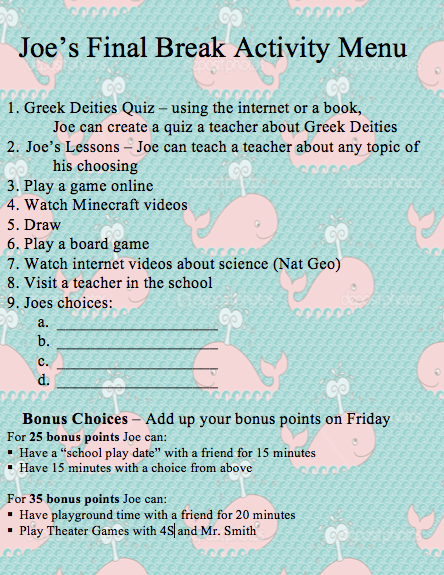
This is the Reinforcement Menu that I created for Joe. The reinforcers are specific to Joe's interests and were chosen because they are true motivators to him. There is also a section where Joe can choose new reinforcers weekly. The bonus checks exist to motivate Joe to choose the incompatible behaviors to crying more often that his check sheets will allow, therefore providing him with extra reinforcement.
Part 2: Behavior Intervention Plans (BIP)
After the function of the behavior is determined, a plan will be created by the team. The plan will detail several things:
1) The target behavior that is being changed and a definition of what the behavior looks like
2) The function of the behavior
3) Accommodations provided to manage the antecedents
4) Appropriate consequences if the behavior is exhibited
5) A plan for fading the BIP
1) The target behavior that is being changed and a definition of what the behavior looks like
2) The function of the behavior
3) Accommodations provided to manage the antecedents
4) Appropriate consequences if the behavior is exhibited
5) A plan for fading the BIP
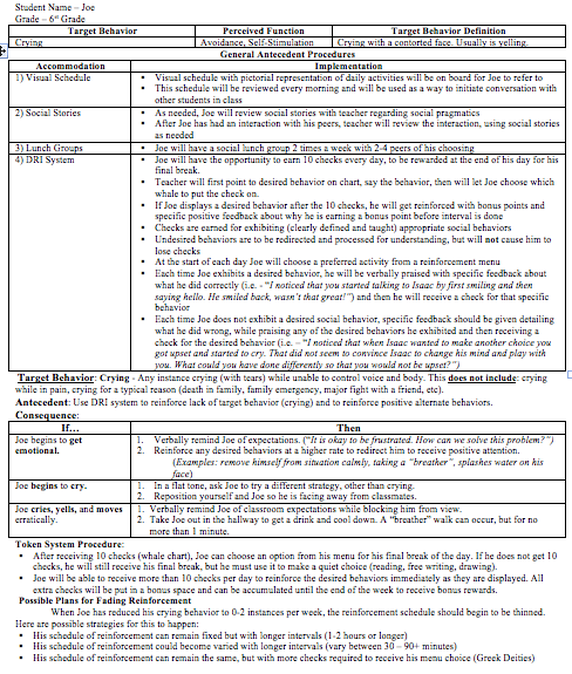
This is an example of a behavior plan that I created for a former student, "Joe."
Differential Reinforcement Plans
|
Differential Reinforcement Plans reinforce only the behaviors that you want to increase, while ignoring other behaviors, if possible. There are 5 different types of differential reinforcement plans:
Differential Reinforcement of Alternate behaviors (DRA) - This type of plan is used when there is a specific behavior being reinforced that is NOT the maladapted behavior. For example, if you are trying to reinforce using a "Take a Break" card for a child that needs frequent breaks, you would only reinforce (with praise and a break) when the child uses his/her "Take a Break Card". Differential Reinforcement of Other behaviors (DRO) - This type of plan is used when reinforcement can be given to all other behaviors OTHER than the maladapted behavior. This plan is usually implemented on an interval schedule, and reinforcement is given when the behavior is not displayed in the given amount of time. Click here for more information about DRO plans. Differential Reinforcement of Incompatible behaviors (DRI) - This type of plan is used when there is a reinforced behavior that is INCOMPATIBLE with the maladapted behavior. For example, if you want to stop a child from running in the hallway, they will be reinforced when they walk, because it is impossible to walk and run at the same time. Differential Reinforcement of Higher-rates of behavior (DRH) - This type of plan is used when reinforcement occurs when the replacement behavior occurs at a HIGHER FREQUENCY. This plan is used to increase a desirable behavior. Differential Reinforcement of Lower-rates of behavior (DRL) - This type of plan is used when reinforcement occurs when the maladapted behavior occurs at a LOWER FREQUENCY. This plan is used to decrease an undesirable behavior. |
This video does a great job explaining the differences between the two most commonly used differential reinforcement plans: the DRA and DRO.
|
DRI Plan - An example:
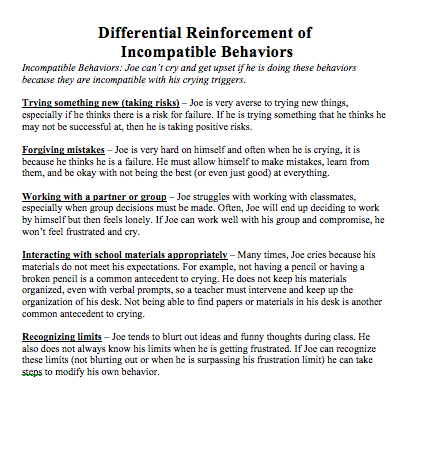
These are the incompatible behaviors that I would reinforce to reduce the appearance of crying.
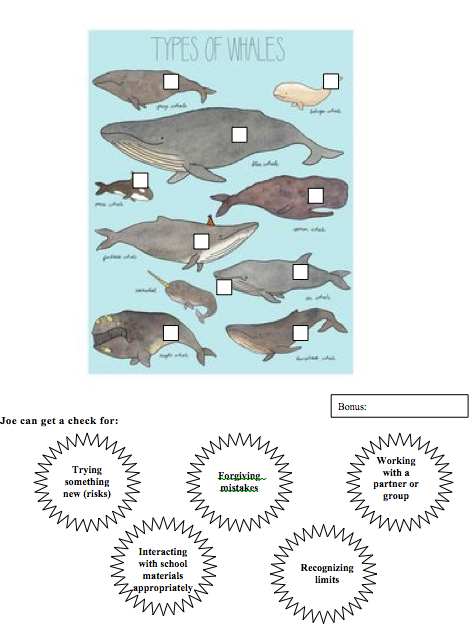
This DRI page gives Joe 10 opportunities to get checks for displaying the behaviors listed at the bottom of the page.
|
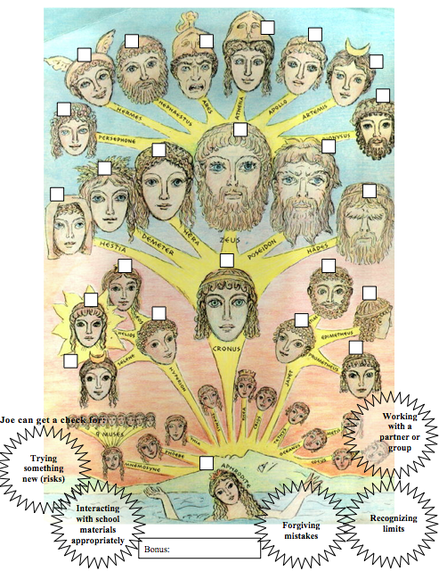
This DRI page gives Joe 10 opportunities to get checks for displaying the behaviors listed at the bottom of the page.
|
Behavior Plans, PBIS, and RtI
Behavior plans used in a PBIS (Positive Behavior Intervention System) focus on reinforcing positive behaviors. Data is collected, a plan is implemented, data is collected again to see if the interventions are working, then decisions are made about further interventions. The team may decide to fade the supports, change the supports, or try a new plan entirely. This makes PBIS a RtI (Response to Intervention) system because it is focused on data how the student responded to the interventions. Similarly to RtI in special education, interventions should only be used if they will result in positive growth. Otherwise, new interventions should be put in place. For more information about PBIS, click here.
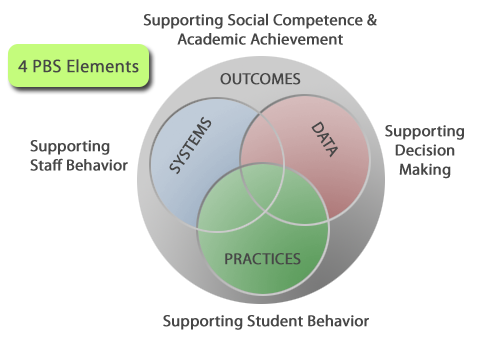
In a PBS system, DATA is used to support decision making. It will lead to PRACTICES that support student behavior. In order to implement effective supports, SYSTEMS must be in place to support staff behaviors. Finally, the OUTCOMES are meant to support social competence and academic achievement.
Schedules of Reinforcement - Fading Support
Once a behavior plan begins to make a positive impact on the behavior of a student, a plan should be made to slowly fade out this support. One way this is done is to reinforce behaviors on a different schedule. Maybe more checks are needed to receive a reward. Maybe checks are given at a longer interval or a varied (unpredictable) interval. Another way behavior plans are faded is by moving from extrinsic, tangible reinforcers (food and praise) to intrinsic reinforcers such as pride and enjoyment of the work.
Fading reinforcement plans is incredibly important because then the behaviors can be internalized, rather than always relying on a reinforcer.
Fading reinforcement plans is incredibly important because then the behaviors can be internalized, rather than always relying on a reinforcer.
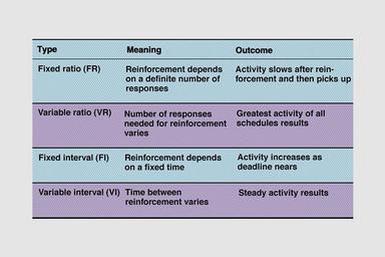
This chart shows the different ways to reinforce behaviors.
Continuous schedules happen every time a behavior occurs. This is the quickest way to modify behavior but is the hardest to implement in school because of the attention and consistency needed.
Partial reinforcement schedules:
The interval refers to the amount of time between reinforcement.
The ratio refers to the number of times a behavior is displayed.
Fixed intervals or ratios provide a consistent reinforcement schedule.
Variable intervals or ratios provide an unpredictable or changing reinforcement schedule.
Continuous schedules happen every time a behavior occurs. This is the quickest way to modify behavior but is the hardest to implement in school because of the attention and consistency needed.
Partial reinforcement schedules:
The interval refers to the amount of time between reinforcement.
The ratio refers to the number of times a behavior is displayed.
Fixed intervals or ratios provide a consistent reinforcement schedule.
Variable intervals or ratios provide an unpredictable or changing reinforcement schedule.
Part 3: Behavior Plans for Students with Special Needs: Anxiety and Autism
Behavior plans can be very helpful when working with students with special needs. They provide consistency and an RtI approach that can help find the correct interventions.
A note for working with students with anxiety: consequences are tricky because the student is NOT in control of their behavior when they are having an anxiety attack. Teachers and their anxious students should instead focus on managing the antecedents that cause anxiety-based maladapted behaviors.
A note for working with students with anxiety: consequences are tricky because the student is NOT in control of their behavior when they are having an anxiety attack. Teachers and their anxious students should instead focus on managing the antecedents that cause anxiety-based maladapted behaviors.
|
This video provides a general understanding of Behavior Intervention Plans (BIP) to use when working with students with autism.
|
This video provides insight into working with students with autism and anxiety. The video shows the implementation of a reinforcement plan.
|
Part 4: Other Behavior Management Tools
There are many strategies that teachers can use to manage the behavior of students. Some of these strategies could be implemented as a whole group, others work best on an individual basis.
Extinction - Extinction refers to the process of eliminating all kinds attention from maladapted behaviors. Extinguishing behaviors should ONLY be used if you can tolerate the maladapted behavior increasing for a time. Without the attention, the behavior often increases, with the attempt to get more attention. An example of correct use of extinction is ignoring when a student calls out. For a while, the student may call out more frequently (to get the attention they need), but eventually, calling out will not get attention, so the student will start raising his/her hand (thereby receiving attention in a positive way).
Extinction should NOT be used when the behavior can not increase. An example of when NOT to use extinction is when a student is hurting themselves or others. This behavior can not increase, so therefore should not be extinguished.
If...Then... - These behavior/consequence agreements can be used as a whole class intervention. The If...Then... charts define maladapted behaviors and their consequences BEFORE a behavior is exhibited. This provides clear expectations for all students. For example, IF you do not complete your homework, THEN you will have a working snack to complete it. When behaviors and consequences are clearly defined, students will know what is expected of them.
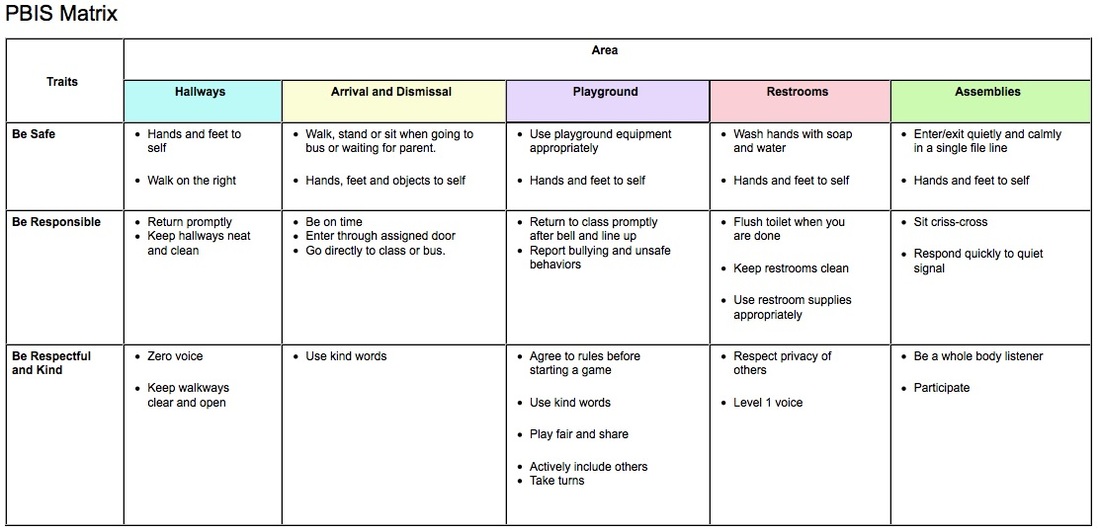
Behavior Matrix - This is a chart that is displayed in a classroom that defines behavior expectations in each area of the classroom or school. See example below:
Extinction - Extinction refers to the process of eliminating all kinds attention from maladapted behaviors. Extinguishing behaviors should ONLY be used if you can tolerate the maladapted behavior increasing for a time. Without the attention, the behavior often increases, with the attempt to get more attention. An example of correct use of extinction is ignoring when a student calls out. For a while, the student may call out more frequently (to get the attention they need), but eventually, calling out will not get attention, so the student will start raising his/her hand (thereby receiving attention in a positive way).
Extinction should NOT be used when the behavior can not increase. An example of when NOT to use extinction is when a student is hurting themselves or others. This behavior can not increase, so therefore should not be extinguished.
If...Then... - These behavior/consequence agreements can be used as a whole class intervention. The If...Then... charts define maladapted behaviors and their consequences BEFORE a behavior is exhibited. This provides clear expectations for all students. For example, IF you do not complete your homework, THEN you will have a working snack to complete it. When behaviors and consequences are clearly defined, students will know what is expected of them.
Behavior Matrix - This is a chart that is displayed in a classroom that defines behavior expectations in each area of the classroom or school. See example below:
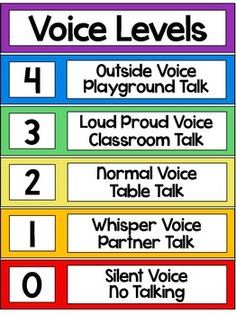
Levels of Behavior - This is a simple system to set up in a classroom. The teacher identifies different types of behavior that can occur during the school day. Usually this focuses on voice and volume, but can be modified to include movement, speed, and focus levels.
Modeling - Teachers should model positive interactions and behaviors. A lot of power can come from students witnessing a teacher model correct behaviors. Modeling can be done quickly, on the stop, and shows concrete alternate behaviors.
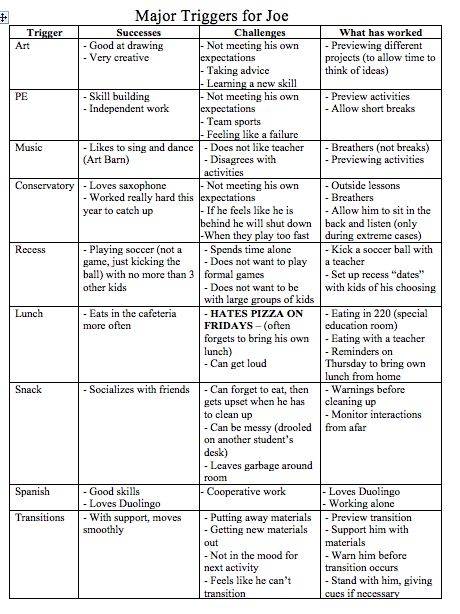
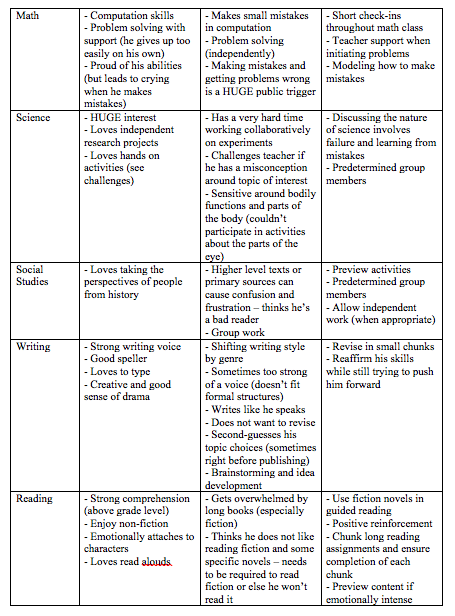
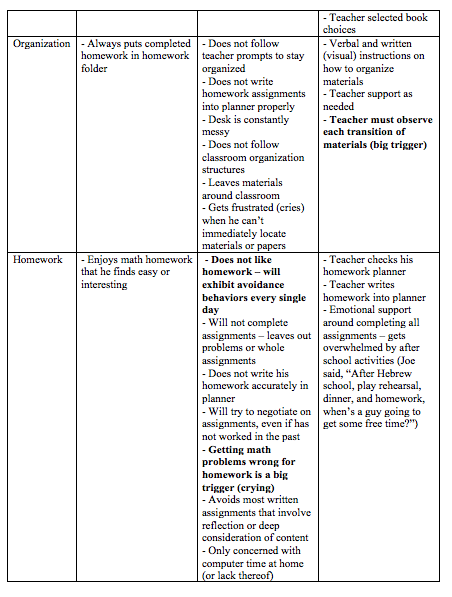
Knowing your Students Well - One of the best ways to manage behavior of students is to know them very well. Knowing students' triggers and successes can help avoid potential problem areas and can help build upon their known strengths. This is an example for "Joe":
Bibliography
Applied Behavior Strategies. (2010-2015). Retrieved April 1, 2015, from Reinforcement 101:
http://www.appliedbehavioralstrategies.com/reinforcement-101.html
DesMaisons, T. (2012, December 14). Anima. Retrieved July 20, 2015, from Animallearning.com:
http://animalearning.com/2012/12/14/a-positive-minded-primer-on-punishment-and-reinforcement-with-a-
buddhist-twist-part-1-of-2/positive-reinforcement-matrix-buddhist-style-for-blog-jpg/
Differential Reinforcement. (2011). Retrieved July 21, 2015, from Special Learning: http://www.special-
learning.com/article/differential_reinforcement PBIS - School. (2015). Retrieved July 25, 2015, from PBIS:
https://www.pbis.org/school
Reagan, A. (n.d.). Differential Reinforcement of Other Behaviors (DRO)/Omission Training. Retrieved July 21, 2015, from Green
River Regional Educational Cooperative: http://www.grrec.ky.gov/CaveWeb/autism/ASD%20Webpage/Module%203/-
%20How%20To%20DRO.pdf
Sadowski, K. (2012, August 31). What are Functional Assessments and the Four Main Functions of Behavior? Retrieved July 21,
2015, from North Shore Pediatric Therapy: http://nspt4kids.com/therapy/what-are-functional-assessments-and-the-four-main-
functions-of-behavior/
Applied Behavior Strategies. (2010-2015). Retrieved April 1, 2015, from Reinforcement 101:
http://www.appliedbehavioralstrategies.com/reinforcement-101.html
DesMaisons, T. (2012, December 14). Anima. Retrieved July 20, 2015, from Animallearning.com:
http://animalearning.com/2012/12/14/a-positive-minded-primer-on-punishment-and-reinforcement-with-a-
buddhist-twist-part-1-of-2/positive-reinforcement-matrix-buddhist-style-for-blog-jpg/
Differential Reinforcement. (2011). Retrieved July 21, 2015, from Special Learning: http://www.special-
learning.com/article/differential_reinforcement PBIS - School. (2015). Retrieved July 25, 2015, from PBIS:
https://www.pbis.org/school
Reagan, A. (n.d.). Differential Reinforcement of Other Behaviors (DRO)/Omission Training. Retrieved July 21, 2015, from Green
River Regional Educational Cooperative: http://www.grrec.ky.gov/CaveWeb/autism/ASD%20Webpage/Module%203/-
%20How%20To%20DRO.pdf
Sadowski, K. (2012, August 31). What are Functional Assessments and the Four Main Functions of Behavior? Retrieved July 21,
2015, from North Shore Pediatric Therapy: http://nspt4kids.com/therapy/what-are-functional-assessments-and-the-four-main-
functions-of-behavior/