Attention Deficit Disorder/
Attention Deficit Hyperactivity Disorder
By: Julia Cohen
Attention Deficit Disorder and Attention Deficit Hyperactivity Disorder are the most common disorders that affect children and adolescents today. ADD and ADHD affect around five to eleven percent of children. The disorders cause symptoms that revolve around inattention, hyperactivity, and impulsivity. Although the exact cause of the disorders is unknown, they are linked to genetics and several external factors. ADD and ADHD can have significant affects on the brain development and maturation of children and adolescents who are affected by them.
Today, there are a variety of positive behavior interventions and other resources to help and support the learning of students who struggle with attentional disorders. Many sources of information and strategies are available to parents and teachers who aim to help students learn and succeed to the best of their ability.
Today, there are a variety of positive behavior interventions and other resources to help and support the learning of students who struggle with attentional disorders. Many sources of information and strategies are available to parents and teachers who aim to help students learn and succeed to the best of their ability.
http://www.chrisdendy.com/abc.htm
|
Below: This video below gives an overview of some facts and characteristics of both ADD and ADHD.
Above: Experts on ADD and ADHD provide advice on how to work with and support students with the disorder.
|
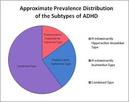
http://daughterofmaat.hubpages.com/hub/Adult-ADHD-Its-Not-Just-for-Kids: There are three types of ADHD: predominantly hyperactive and impulsive, predominantly inattentive, or a combination of the two. This chart above shows the prevalence of each subtype. 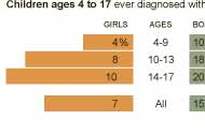
<http://www.nytimes.com/interactive/2013/03/31/us/adhd-in-children.html?ref=health&_r=0>
Percentage of children diagnosed with ADD/ADHD by age group and gender. |
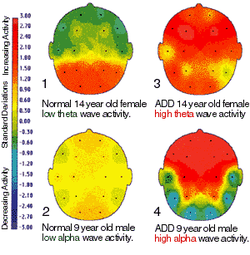
http://www.earthturns.com/Attention-Deficit-Hyperactivity-Disorder-s/3637.htm:
The picture above shows the difference in brain activity between a student with ADD and a student without ADD |
Causes:
The exact cause of ADD/ADHD is unknown. The disorders are often linked to genetics. It can also be the result of other factors, such as:
Brain injury
Smoking and drinking during pregnancy
Disfunction of Neurotransmitters to the brain.
Characteristics:
Hyperactivity
Impulsiveness
Inattentiveness
Affects on Learning:
ADD/ADHD causes the brain to develop and mature at a slower rate than normal.
Children with the disorder often have trouble acting mature and behaving responsibly
The disorder can cause difficulty in paying attention in class, completing work, organizing information, reading comprehension, and a variety of other aspects of academic life.
Intervention:
Medication
Cognitive behavior therapy
Methods of supporting learning and increasing strengths:
-Communication between schools, teachers, and parents to determine how to best help students
-Behavior intervention plans to develop intervention strategies and supports.
-Provide time for physical activity/exercise
-Provide extra assistance in instruction
-Organize classroom environmental aspects, as well as the space and belongings of students with ADD/ADHD
-Create structure and make the daily schedule of activities accessible
-Provide a stress ball or a "fidgeting" toy to help student focus better.
References:
http://www.webmd.com/add-adhd/guide/adhd-causeshttp://www.nytimes.com/2013/04/01/health/more-diagnoses-of-hyperactivity-causing-concern.html?pagewanted=all&_r=0
www.chrisdendy.com/abc.htm
http://www.nimh.nih.gov/health/topics/attention-deficit-hyperactivity-disorder-adhd/index.shtml#part1
http://www.chadd.org/Understanding-ADHD/Parents-Caregivers-of-Children-with-ADHD/Symptoms-and-Causes/Researchers-on-ADHD-Research.aspx
http://www.addvance.com/help/parents/helping_child.html)
http://psychcentral.com/blog/archives/2013/09/25/8-ways-to-help-kids-with-adhd-succeed-in-school/
The exact cause of ADD/ADHD is unknown. The disorders are often linked to genetics. It can also be the result of other factors, such as:
Brain injury
Smoking and drinking during pregnancy
Disfunction of Neurotransmitters to the brain.
Characteristics:
Hyperactivity
Impulsiveness
Inattentiveness
Affects on Learning:
ADD/ADHD causes the brain to develop and mature at a slower rate than normal.
Children with the disorder often have trouble acting mature and behaving responsibly
The disorder can cause difficulty in paying attention in class, completing work, organizing information, reading comprehension, and a variety of other aspects of academic life.
Intervention:
Medication
Cognitive behavior therapy
Methods of supporting learning and increasing strengths:
-Communication between schools, teachers, and parents to determine how to best help students
-Behavior intervention plans to develop intervention strategies and supports.
-Provide time for physical activity/exercise
-Provide extra assistance in instruction
-Organize classroom environmental aspects, as well as the space and belongings of students with ADD/ADHD
-Create structure and make the daily schedule of activities accessible
-Provide a stress ball or a "fidgeting" toy to help student focus better.
References:
http://www.webmd.com/add-adhd/guide/adhd-causeshttp://www.nytimes.com/2013/04/01/health/more-diagnoses-of-hyperactivity-causing-concern.html?pagewanted=all&_r=0
www.chrisdendy.com/abc.htm
http://www.nimh.nih.gov/health/topics/attention-deficit-hyperactivity-disorder-adhd/index.shtml#part1
http://www.chadd.org/Understanding-ADHD/Parents-Caregivers-of-Children-with-ADHD/Symptoms-and-Causes/Researchers-on-ADHD-Research.aspx
http://www.addvance.com/help/parents/helping_child.html)
http://psychcentral.com/blog/archives/2013/09/25/8-ways-to-help-kids-with-adhd-succeed-in-school/
Strategies/Resources:
Information on ADD/ADHD- http://addinschool.com/interventions-adhd-elementary-school/
Tips for managing symptoms and behavior- http://www.helpguide.org/mental/adhd_add_teaching_strategies.htm
Articles:
"Helping your child with ADD (ADHD) in School"-http://www.addvance.com/help/parents/helping_child.html
"8 ways to help kids with ADHD succeed in school"-http://psychcentral.com/blog/archives/2013/09/25/8-ways-to-help-kids-with-adhd-succeed-in-school/
"Strategies for Teaching Youth With ADD and ADHD"- http://www.ldonline.org/article/13701/
"Teaching Students with ADHD to F.O.C.U.S: A Learning Strategy"- http://education.jhu.edu/PD/newhorizons/Journals/Winter2011/Scott
Resource Articles:
"Researchers on ADHD Research"-http://www.chadd.org/Understanding-ADHD/Parents-Caregivers-of-Children-with-ADHD/Symptoms-and-Causes/Researchers-on-ADHD-Research.aspx
"The ABC's of ADD and ADHD!!!: Impact on School Performance"- http://www.chrisdendy.com/abc.htmhttp://www.nytimes.com/2013/04/01/health/more-diagnoses-of-hyperactivity-causing-concern.html?pagewanted=all&_rhttp://www.chrisdendy.com/abc.htm
"A.D.H.D. Seen in 11% of U.S. Children as Diagnoses Rise" - http://www.nytimes.com/2013/04/01/health/more-diagnoses-of-hyperactivity-causing-concern.html?pagewanted=all&_rhttp://www.chrisdendy.com/abc.htm