Twice Exceptional Students
Twice Exceptional Students are students that have a learning disability defined by IDEA, receive special education services, and also possess a gifted ability in a specific academic area, the arts, or in any general intellectual capability.

Summary
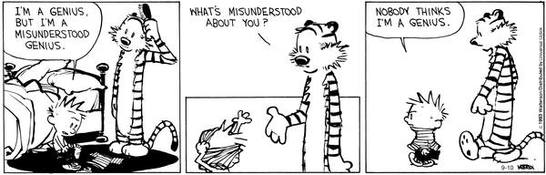
Many Twice Exceptional students are either unidentified or misidentified. Even though Twice Exceptional students have both a gift and a disability, sometimes only one one of these is actually visible in a classroom setting. A student might be diagnosed with Dyscalculia and receive special education services for this disability, but the teacher might not see that the student is gifted in playing musical instruments as well.
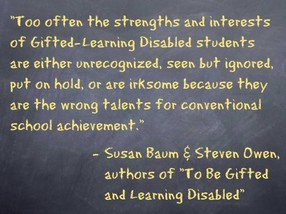
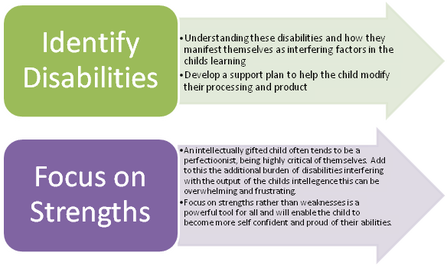
All students have strengths and weaknesses in different skills or subject areas. As elementary teachers, we should always try to find the students' strengths and interests and incorporate them into the content; this is especially true for Twice Exceptional children. All Twice Exceptional children are unique from one another because their strengths and weaknesses are all different. Twice Exceptional students might differ from typical children because 2e students might be highly critical of themselves because of their gift, which can add to their frustration of their disability.
All students have strengths and weaknesses in different skills or subject areas. As elementary teachers, we should always try to find the students' strengths and interests and incorporate them into the content; this is especially true for Twice Exceptional children. All Twice Exceptional children are unique from one another because their strengths and weaknesses are all different. Twice Exceptional students might differ from typical children because 2e students might be highly critical of themselves because of their gift, which can add to their frustration of their disability.
|

|
Twice Exceptional students' strengths and weaknesses are very specific. For example, a Twice Exceptional student shown in this video has a gift in math and science subjects, but he has a "disability in writing" [the disability was not specified further than this] and used to have a speech impairment. The student also mentions that he struggles with reading. In this student's case, his special education teacher should incorporate his favorite math and science topics into reading and writing to capture his interests. He can then strengthen his reading and writing skills while using the confidence that he has in math and science. Teachers of Twice Exceptional students need to ensure that these students have the opportunity to feel successful in all subject areas, including the ones they succeed in and those that they struggle with.
Andrew Collins, a Twice Exceptional student shared his feelings on his lack of support in school in his article, Limited and Limitless: My Experience as a Twice-Exceptional. Although he did not receive the services in school that he needed, his feelings as a Twice Exceptional student might be parallel with other Twice Exceptional students feeling frustrated in school.
|
|
|
|
How are Twice Exceptional students Identified?
Montgomery County Public Schools, Maryland, has a plan to do a broad-based screening for all students that are nominated for an academic gift in Grade 2, and then again in Grades 3-5. Students are given assessments that evaluate their critical thinking,
problem solving, verbal reasoning, and more. The who excel at these assessments would be considered gifted. [Read more about this specific school district's guidelines about 2e students here]. Students who are gifted, and also have a disability or receive special education services, would then be identified as Twice Exceptional.
Federal laws protect children with disabilities; they must be given support and classroom changes that they need to succeed. There is no law for gifted children though, so children's gifts are often overlooked.
Federal laws protect children with disabilities; they must be given support and classroom changes that they need to succeed. There is no law for gifted children though, so children's gifts are often overlooked.
Challenges for Identifying Twice Exceptional students
|
Gifts mask disability: Students are first identified as gifted in a specific area, but are showing difficulties in other areas and overall performing at or under grade level. Since this student is known as gifted, the teacher or family attribute their underachievement as a lack of motivation, self-esteem or
laziness.
|
Disability masks gifts: A student who is diagnosed with a disability might not have their gift recognized. The severity of their disability might be masking their gift. Also, teachers might underestimate their intellectual abilities because of low assessment scores.
|
Gifts and disability mask each other: A student might be performing on average level with no seen disabilities, because their gifts and disabilities are masking each other.
|
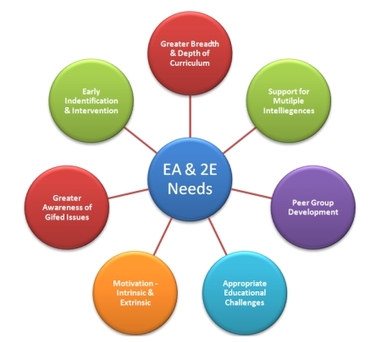
How can teachers help Twice Exceptional students be successful?
|
Be an Advocate for their Gift
Teachers and parents need to collaborate to decide what education programs would be best for the gifted child. This book, Academic Advocacy for Gifted Children, by Barbra Jackson Gilman, is recommended by the 2e: Twice Exceptional Newsletter as an essential resource for planning a gifted child's education.
|
Resources
2e: Twice Exceptional Newsletter is a resource for families, teachers, and other professionals about 2e and how to help these students.
Past articles that have been published in the 2e: Twice Exceptional Newsletter are available to be purchased. These articles include topics such as, "AD/HD in gifted children," "Providing support for 2e students in the classroom," and more.
A Guidebook for Twice Exceptional Students; Supporting the Achievement of Gifted Students with Special Needs, Montgomery County Public Schools Department of Curriculum and Instruction.
Dysgraphia in Twice–exceptional Kids: How to Turn Frustration Into Success Using Technological Tools!, by Sue Ramin–Hutchison and Merri Domer, May 2011
Gifted Children with Asperger Syndrome by Deirdre Lovecky, Ph.D, June 2005
Gifted Children’s Challenges With Learning and Attention Issues, by Peg Rosen, June 2014
A Nation Deceived: How Schools Hold Back America’s Brightest Students; Chapter 11: Acceleration and Twice Exceptional Students, 2004
Dysgraphia in Twice–exceptional Kids: How to Turn Frustration Into Success Using Technological Tools!, by Sue Ramin–Hutchison and Merri Domer, May 2011
Gifted Children with Asperger Syndrome by Deirdre Lovecky, Ph.D, June 2005
Gifted Children’s Challenges With Learning and Attention Issues, by Peg Rosen, June 2014
A Nation Deceived: How Schools Hold Back America’s Brightest Students; Chapter 11: Acceleration and Twice Exceptional Students, 2004
Literature/Resources for Students
The Curious Incident of the Dog in the Night-Time, by Mark Hadden
|
All Kinds of Minds, by Mel Levine
|