Impact of Special Needs
  • BLOG 2017
  • IMPACT
    • History of Special Education Christina Pressley
    • INQUIRY >
      • RESEARCH AVENUES >
        • Marshall Memo
    • SYLLABUS >
      • Norms
      • Council for Exceptional Children
      • Flight Practice
      • Ladder of Feedback
      • Marshmallow Challenge
      • MeMoves!
      • National Teaching Norms
      • Scavenger Hunt
      • Unthinkables
  • FOUNDATIONS
    • Common Core >
      • Mathematics >
        • Math Graphic Organizers
        • Math: Subitizing and Ten Frames
        • Math Inclusion Resources and Strategies
      • Literacy >
        • Alphabet Awareness
        • Classroom Labels
        • Close Reading Strategies
        • The Daily Five
        • Dialogic and Guided Reading
        • Phonics Instruction
        • Phonological Awareness
        • Story Grammar Markers
        • Writing
      • TECHNOLOGY RESOURCES FOR LEARNING >
        • ACCESSIBLE INSTRUCTIONAL MATERIALS
        • Assistive Technology >
          • Assistive Technology Andrew
        • The Flipped Classroom in SPED
        • Science >
          • STEM
        • WEBSITES FOR LEARNING >
          • Web 2.0
          • cool tools
    • IEP >
      • Assessment
      • Terminology
      • Accommodations >
        • Assistive Technology >
          • Technology
          • AIM
        • MCAS Accommodations
      • Documents
      • Goals and Objectives
      • Transition Services >
        • Early Childhood Transition
      • Early Intervention
      • 504 Plans
    • INCLUSION >
      • Child Study Teams >
        • CST Report (Action Plans)
      • DCAP
      • RTI >
        • RTI in SLD Determination Lauren A
        • MA Tiered System of Supports
      • Observations
      • PALS: PEER ASSISTED LEARNING STRATEGIES
      • Para Educator
    • DISABILITY AWARENESS >
      • IRIS Resources STAR Legacy Modules
    • EDUCATIONAL STANDARDS >
      • 21st Century Skills
      • Common Core
      • IDEA >
        • Dear Colleague
        • ADA Americans with Disability Act
      • Special Education History >
        • Timelines in Special Education
    • FAMILY >
      • DIVERSITY
      • ADA and ADULTHOOD
      • Stigma in Special Needs in Latino Family Emily Burdick
  • TOPICS
    • Transgender Youth
  • LEARNING THEORIES
    • LEARNING THEORIES A-G >
      • ABA Jenna
      • All Kinds of Minds
      • Bloom's Taxonomy
      • Behaviorism
      • Bronfenbrenner’s Theory
      • Child Development
      • Cognitivism
      • Constructivism
      • GRIT
      • Growth Mindset
    • LEARNING THEORIES H-Z >
      • Kinesthetic Learning Eilish Reynolds
      • Learning Styles
      • Meaning Making
      • Motivation
      • Neuroscience
      • Building Relationships Katherine Bonilla
      • Social Learning Theory
      • Teaching for Understanding
      • Thinking Maps
      • UDL >
        • Assistive Technolog Jacqueline
        • UDL and the Common Core
        • UDL-Jenny/Lauren
      • Visible Thinking
  • DISABILITIES
    • AUTISM (ASD) >
      • Autism >
        • Autism Family Info Lindsey Blackman
        • Pink on the Spectrum Sara Cane
        • Autism Troy Sargent >
          • Autism and ABA Haley Award
          • Autism Janine Steinhauser
          • Autism James McDonough
        • Autism Rebecca Siegel
        • Autism and Language
        • Autism Kat
        • Autism and Adulthood
        • Autism in an Inclusive Classroom Kathryn N
        • Autism Dana Moody
        • Autism Non-Verbal Justin
      • ASD Resources
      • Autism-Nicky >
        • ABA in Autism Intervention Lauren C
      • Asperger's Syndrome Leeanne
    • COMMUNICATION >
      • Apraxia Victoria >
        • Apraxia Gabrielle D'Avolio
      • Communication Resources >
        • Expressive Language-Chelsey
      • Select Mutism
    • DEVELOPMENTAL DELAY >
      • Fine and Gross Motor Devel.-Denise >
        • Motor Articles
    • EMOTIONAL (BEHAVIOR) >
      • Bipolar Disorder Cailey >
        • Bipolar Disorder Caitlin Worthen
      • Behavior Resources
      • Mental Health Needs in College Peter Rakes
      • Relational Aggression Meghan Lederhos
      • Emotional Apps Katherine Bonilla
      • Trauma Supportive Practice Samantha Sinotte
    • HEALTH >
      • Cancer
      • ADHD and ADD >
        • ADHD Isabella Delmoral
        • ADHD Julia
        • ADHD Olivia Pizzi
        • ADD/ADHD >
          • ADHD Jenny/Lauren
          • ADHD Sarah Morgenthaler
      • Health Resources
    • INTELLECTUAL >
      • Acquired Brain Injury >
        • Intellectual Resources
      • Down Syndrome
      • Down Syndrome Jennifer Whitman
      • Prader-Willi Syndrome Samantha Curtis
    • NEUROLOGICAL >
      • Brain Development-Kate
      • Memory-Sarita
      • EXECUTIVE FUNTIONING >
        • Executive Functioning Disorder Laura Brady
      • Rett Syndrom Brycelyn
      • SENSORY PROCESSING DYSREGULATION >
        • SI Resources >
          • Sensory Integration-Steph >
            • SI Reference Articles
      • Fetal Alcohol Syndrome-Mary >
        • Fetal Alcohol Syndrome Elizabeth Watts
    • PHYSICAL >
      • Hearing Disability Rachel Jones
      • Physical Resources
      • Student Integration After Hospitalization Kathryn R
    • SENSORY >
      • HEARING >
        • Hearing Loss Yan Li Xu
        • Hearing Impairment Brianne Syring
        • Hearing Resources
        • Deaf and Hard of Hearing Brianna Normile
      • Sensory Processing Disorder Mikaela Newell
      • VISION >
        • Vision Resources
    • SPECIFIC LEARNING >
      • SLD Elizabeth Mossop
      • NVLD Nicole Snyder
      • LD Resources >
        • Dyscalculia Lily Chase-Lubitz
        • Dysgraphia Erin Bruce
        • Reading >
          • Dyslexia-Anthony >
            • Dyslexia Lily Montagna
            • Dyslexia Victoria Small
            • Dyslexia 2 Tiffany
            • Dyslexia Meghan
            • Dyslexia Colleen Talbot
          • Early Literacy Resources
          • LD and IDEA Issue
          • Reading by the Rules
        • Content
        • Math
        • Writing
        • Technology >
          • Reading Comprehension Strategies Meredith Chen
        • Teaching
    • TWICE EXCEPTIONAL >
      • Twice Exceptional Articles
      • Twice Exceptional Students Kelcy West
      • Twice Exceptional-Melissa
  • BEHAVIOR
    • CLASSROOM MANAGEMENT >
      • A-J >
        • 21st Century Learning
        • Behavior Modification >
          • Behavior Management Jon Weinberger
        • Bloom's Taxonomy
        • Circle of Friends
        • Collaborative Problem Solving
        • Culturally Responsive Pedagogy
        • The Daily Five
        • Differentiated Instruction
      • K-Z >
        • Kids and War
        • MeMoves!
        • Responsive Classroom
        • Socia Skills Curriculums Jessica Fox
        • Social & Emotional Learning Carol Yourman
        • Social Thinking
        • Strategies for Aggression-Jim
        • Universal Design for Learning
    • PREVENTING BULLYING >
      • Good Play Project
  • PROJECTS 2018
    • INQUIRY >
      • A-K
      • L-Z
Picture

Bipolar Disorder in Children

Welcome to my site on Bipolar Disorder in Children! 

This site was built based on a long-standing interest I’ve had in Bipolar Disorder.  After spending time working with a young Bipolar child, I realized I knew almost nothing about Bipolar beyond the stigma of "uncontrolled anger" and "unpredictable mood swings".  I hope this site will help you learn as much as I have to challenge that stigma.

Little research has been done directly on pediatric Bipolar Disorder, but the disorder follows many of the characteristic patterns of adult Bipolar.  It is characterized by unusual shifts in mood, between extreme highs called mania and extreme lows of depression, both of which occur outside of the normal “ups and downs” that everyone experiences naturally.

Unlike most Bipolar adults, Bipolar children tend to have much more abrupt changes in mood, and cycle more frequently between mania and depression, with less time without symptoms between episodes.  Symptoms of mania include inattentiveness, sleeplessness, euphoria and recklessness, and symptoms of depression include anxiety, irritability and thoughts of suicide. Bipolar Disorder
 is treated with a combination of psychotherapy and intensive medication regimens, which help to dull the extremes of each episode, but also come with various intrusive side effects.

Bipolar Disorder significantly affects a child's daily life, and can impact the ability to succeed at school.  Educators can be helpful in providing specific, tailored learning accommodations to students, especially in combating the effects of medication programs on learning, and can be a major support  in helping these children succeed at school.

Explore the site below to learn more about Bipolar Disorder.

Topics Covered 

  • What is Bipolar Disorder?
  • Etiology
  • Symptoms: Mania, Depression
  • Statistics
  • Comorbidity
  • Treatments
  • Effects on Learning
  • Strategies in the Classroom
  • Support Resources

What is Bipolar Disorder?

Bipolar disorder is a brain disorder that causes unusual shifts in mood, energy, and activity levels. It can also make it hard to carry out day-to-day tasks, such as going to school or hanging out with friends. Symptoms are different from the normal ups and downs that everyone goes through from time to time. 

Doctors diagnose bipolar disorder using guidelines from the Diagnostic and Statistic Manual of Mental Disorders (DSM). To be diagnosed, the symptoms must be a major change from your child's normal mood or behavior. There are four basic types of bipolar disorder:
  • Bipolar I Disorder--defined by manic or mixed episodes that last at least 7 days, or by manic symptoms that are so severe that the person needs immediate hospital care. Usually, depressive episodes occur as well, typically lasting at least 2 weeks.
  • Bipolar II Disorder--defined by a pattern of depressive episodes and hypomanic episodes, but no full-blown manic or mixed episodes.
  • Bipolar Disorder Not Otherwise Specified (BP-NOS)--diagnosed when symptoms of the illness exist but do not meet diagnostic criteria for either bipolar I or II. However, the symptoms are clearly out of the person's normal range of behavior.
  • Cyclothymic Disorder, or Cyclothymia--a mild form of bipolar disorder. People with cyclothymia have episodes of hypomania and mild depression for at least 2 years but do not meet the diagnostic requirements for any other type of bipolar disorder.

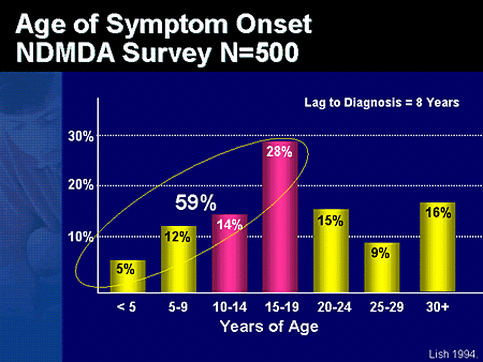
Symptoms of bipolar disorder most often develop in the late teens or early adult years, but some people have their first symptoms during childhood. Learn more.

Etiology

The exact cause of bipolar disorder is unknown, but several factors seem to be involved in causing and triggering bipolar episodes:

  • Biological differences. People with bipolar disorder appear to have physical changes in their brains. 
  • Neurotransmitters. An imbalance in naturally occurring brain chemicals called neurotransmitters seems to play a significant role in bipolar disorder and other mood disorders.
  • Hormones. Imbalanced hormones may be involved in causing or triggering bipolar disorder.
  • Inherited traits. Bipolar disorder is more common in people who have a blood relative (such as a sibling or parent) with the condition. 
  • Environment. Stress, abuse, significant loss or other traumatic experiences may play a role in bipolar disorder. Learn More.
Your browser does not support viewing this document. Click here to download the document.

Symptoms

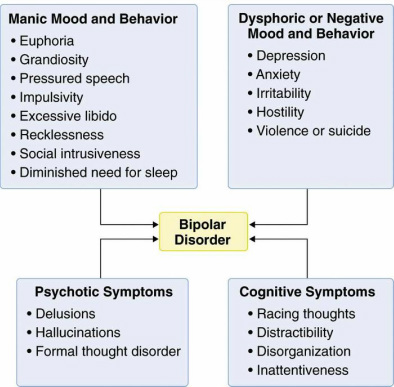
Youth with bipolar disorder experience unusually intense emotional states that occur in distinct periods called "mood episodes." The extreme highs and lows of mood are accompanied by extreme changes in energy, activity, sleep, and behavior.  Learn more. 

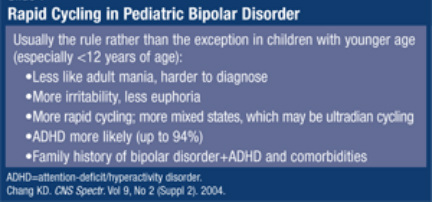
Unlike most adults, children who have pediatric bipolar disorder show abrupt mood swings, periods of hyperactivity followed by lethargy, intense temper tantrums, frustration and defiant behavior. This rapid, severe cycling between moods may produce chronic irritability with few clear periods of peace between episodes. Learn more. 

Bipolar Disorders in children are severe, highly comorbid, chronic, cyclical, and frequently relapsing biopsychosocial mood disorders of childhood and adolescence. The core symptoms of manic and depressive symptoms can be further exacerbated by the secondary problems of comorbidity; teacher, parent, and sibling stress; sleep disruptions; and time spent out of school. Learn more.
Picture
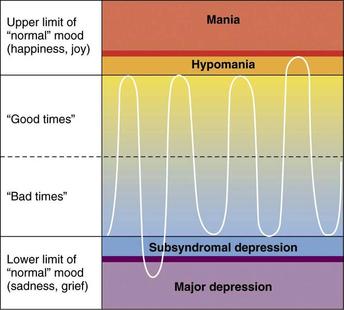
Bipolar episodes occur outside the "normal" limits of mood, on either end of the spectrum.

Mania

BEHAVIORAL CHANGES DURING A MANIC EPISODE
  • Sleeping little but not feeling tired
  • Talking a lot and having racing thoughts
  • Having trouble concentrating or paying attention, jumping from one thing to the next in an unusual way
  • Behaving in risky ways more often, seeking pleasure a lot, and doing more activities than usual.
Picture
Symptom Categories of Bipolar Disorder
Picture
When compared to their adult counterparts, children with Bipolar tend to display more rapid cycling of manic and depressive episodes, with less time in between episodes.

Depression

BEHAVIORAL CHANGES DURING A DEPRESSIVE EPISODE
  • Complaining about pain more often, such as headaches, stomach aches, and muscle pains
  • Eating a lot more or less than usual and gaining or losing a lot of weight
  • Sleeping or oversleeping when these were not problems before
  • Losing energy
  • Recurring thoughts of death or suicide.

Statistics

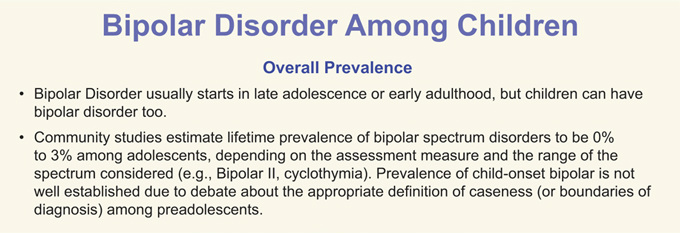
There is not much statistical information to date specifically on the prevalence of childhood bipolar disorders.  Cases more frequently display onset in later adolescence, with at least half of cases being diagnosed prior to age 25. Though the number of diagnosed bipolar cases in children is rising, there is a lot of controversy over whether these are misdiagnoses of disorders with overlapping symptoms, such as ADHD.  
Picture
Picture
Many individuals who are eventually diagnosed with Bipolar Disorder begin displaying symptoms as young children. There is often a lag in diagnosis because in children the symptoms displayed can also be attributed to disorders such as ADHD or anxiety.
Picture
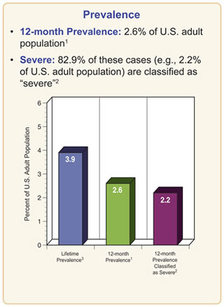
Lifetime Prevalence of Bipolar Disorder among U.S. adults.
Picture
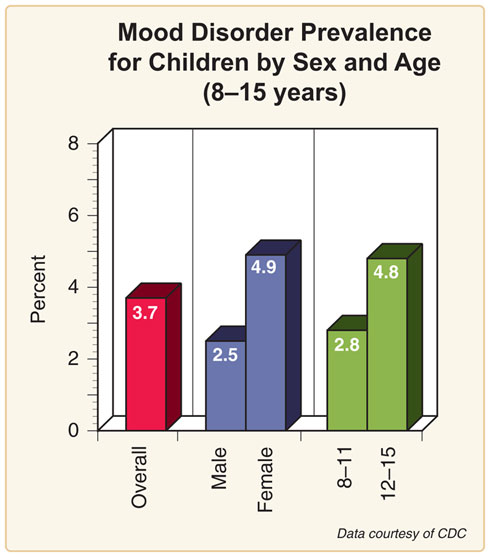
Bipolar Disorder is part of a larger category of Mood Disorders. This chart shows the prevalence and distribution of overall mood disorders in children.

Comorbidity with other Disorders

ADHD

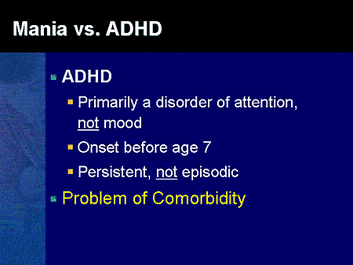
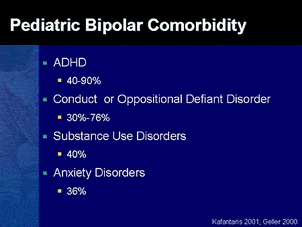
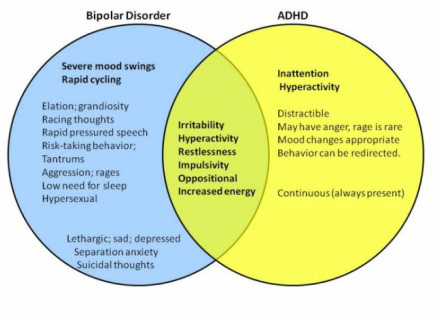
It is difficult for clinicians to differentiate mania vs ADHD, and the real problem is comorbidity. ADHD is primarily a disorder of attention, not mood, with an onset before 7 years of age. It tends to be persistent, not episodic. The real problem is that many patients with mania--children and adolescents--tend to also have ADHD.
Picture
Overlapping symptoms and high rates of comorbidity make diagnosing Bipolar Disorder in children more complicated. This adds to the controversy claiming that Bipolar Disorder is overly diagnosed when mistaking ADHD for a Mood Disorder.


Other Disorders

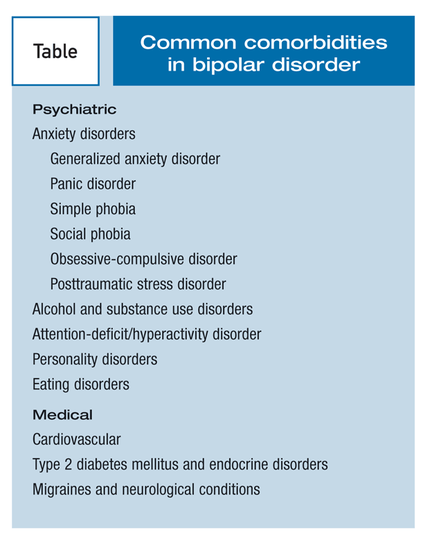
Bipolar Disorder in children often occurs alongside multiple other disorders, making diagnosis and treatment more complicated.
Picture
Picture
Picture

Treatments

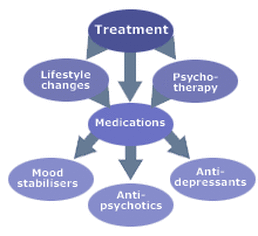
There is no cure for Bipolar Disorder.  However, through strategic treatment, the symptoms can be managed to lessen the impact on the individual's daily life.  Treatments range from psychotherapy to intensive medication programs.

Learn more about treatment options for Bipolar youth.
HealthyPlace.com
National Institute of Mental Health


Therapy

Cognitive behavioral therapy, which helps young people with bipolar disorder learn to change harmful or negative thought patterns and behaviors.

Family-focused therapy, which includes a child's family members. It helps enhance family coping strategies, such as recognizing new episodes early and helping their child. This therapy also improves communication and problem-solving.

Interpersonal and social rhythm therapy, which helps children and teens with bipolar disorder improve their relationships with others and manage their daily routines. Regular daily routines and sleep schedules may help protect against manic episodes.

Psychoeducation, which teaches young people with bipolar disorder about the illness and its treatment. This treatment helps people recognize signs of an impending relapse, allowing them time to seek treatment early, before a full-blown episode occurs. Psychoeducation also may be helpful for family members and caregivers. 
Picture
Picture

Medication

Picture
Mood stabilizers, such as lithium are usually the first choice to treat bipolar disorder. Lithium is approved for the treatment and prevention of manic symptoms in children ages 12 and older. In addition, lithium might act as an antidepressant and help prevent suicidal behavior. However, FDA's approval of lithium was based on treatment studies in adults, not children.

Anticonvulsant medications, originally developed to treat seizures, are also sometimes used as mood stabilizers. They are not approved by the FDA for treating bipolar disorder in children, but your doctor may prescribe one on an "off label" basis. They may be very helpful for difficult-to-treat bipolar episodes. For some children, anticonvulsants may work better than lithium. Examples of anticonvulsant medications include valproic acid or divalproex sodium (Depakote) and lamotrigine (Lamictal).

Atypical antipsychotics are sometimes used to treat symptoms of bipolar disorder. Those approved by the FDA to treat youth with bipolar disorder are risperidone (Risperdal), aripiprazole (Abilify), quetiapine (Seroquel), and olanzapine (Zyprexa). Short-term treatment with risperidone can help reduce symptoms of mania or mixed mania in children ages 10 and up. Some research has indicated that risperidone is more effective in treating mania in young children than other medications. Aripiprazole and quetiapine are approved to treat mania symptoms in children 10–17 years old who have bipolar I, while olanzapine is approved for use in children ages 13–17.


Effects on Learning

Many of the symptoms of Bipolar Disorder, along with those associated with highly common comorbid disorders like ADHD and anxiety, have a tremendous impact on a child's performance in school.

Although research is limited on academic functioning of children with EOBPSD, studies reported that 24% of children with EOBPSD repeated a grade, 13% had learning disabilities, 43% had special education placements, 58% received tutoring, and 30% and 42% had math and reading disabilities, respectively.  Learn More. 
Common Difficulties in School
  • Fluctuations in cognitive abilities, alertness, processing speed, and concentration, which may occur from day to day and may reflect a child's overall mood stability
  • Impaired ability to plan, organize, concentrate, and use abstract reasoning. This can affect behavior and academic performance.
  • Heightened sensitivity to perceived criticism. These children also are far more easily frustrated than a typical child.
  • Hostility or defiance at small provocations, as their moods dominate how they "hear" directions from a teacher
  • Crying for no apparent reason, appearing upset out of proportion to actual events, or seeming inconsolable when distressed. 
  • Side effects from medications. Medications may have cognitive effects or physically uncomfortable side effects that interfere with school performance.
  • Other conditions, such as Attention Deficit/Hyperactivity Disorder (ADHD), which also may be present, compounding any learning challenges. Having one mental health condition does not "inoculate" the child from having other conditions as well.
  • Learning disorders, which are often overlooked in this population. A child's difficulties or frustrations in school should not be presumed to be due entirely to the bipolar disorder. 

Learn More: Massachusetts General Hospital

Picture

Medication's Impact on Learning

Many of the medications used to treat children with Bipolar can cause severe side effects that impact every day functioning.  Many of these side effects affect a child's attention and physical comfort, and can seriously decrease a child's ability to learn in the classroom.
  • Restlessness
  • Frequent urination
  • Dry mouth
  • Bloating or indigestion
  • Sleep problems, such as sleeplessness or drowsiness

  • Joint or muscle pain
  • Drowsiness
  • Dizziness
  • Headache
  • Agitation (feeling jittery)


  • Mood swings
  • Diarrhea
  • Constipation
  • Heartburn
  • Stuffed or runny nose, or other cold-like symptoms
Learn More:  National Institute of Mental Health

Strategies in the Classroom

Symptom: Stress/Irritability

  • Modified or shortened homework (at parents' request or discretion)
  • Modified or shortened classroom assignments
  • Testing in small groups or one on one
  • Positive behavioral intervention plan
  • Notice before any transition or change in schedule
  • Issue the child only one specific direction or command at a time. (Example: ask the student to complete 10 math problems instead of to complete all homework.)
  • Identify a person or place at school where a child can go if symptoms become overwhelming

Symptom: Social Difficulties

  • Training in social skills
  • Training in conflict resolution
  • Training in anger management
  • Training in problem-solving skills
  • Training in self-esteem development

Symptom: Physical Discomfort from Medication

  • Unlimited bathroom use
  • Access to water as needed
  • Permission to move around when needed


Read more about these accommodations:
  • The Balanced Mind Parent Network
  • Juvenile Bipolar Research Foundation
  • SchoolBehavior.com
  • Everyday Health

Symptom: Impaired Concentration and Focus

  • Provision of hard copies of all notes and board work
  • Discreet assistance focusing or remaining on-task.
  • An extra set of books to be left at home.
  • Extended time on homework or projects and/or reduced homework.
  • Assisting the student by helping them break large projects down into smaller pieces and conferencing with them on a regular basis to help them stay on schedule.
  • Word banks or other devices to assist with retrieval of information from memory.


Symptom: Sleep Disruption from Medication

  • Shortened schedule
  • Late start as needed
  • Naps as needed for primary education students
  • Consistent schedule
  • Excuse tardiness or absence due to fatigue, anxiety, depression or other symptoms
Picture
Picture

Resources

Picture
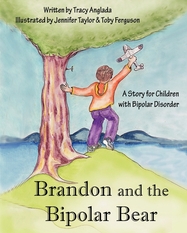
This book is a resource for children that helps them understand their diagnosis and offers reassurance and comfort in stressful moments.
Picture
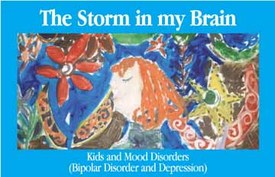
The Storm in my Brain is a book that addresses how children with mood disorders may feel. It is a great resource for kids, their parents, and educators.
Picture
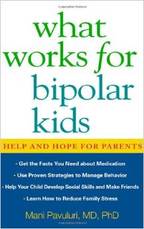
This book is on the DBS Alliance's list for best books for parents with Bipolar children.
Picture

For Children

Kid'sHealth.org - A site that is free of "doctor speak" and is for children and families to learn about all areas of health and growing up.
BPC Children: Kids Page

For Parents

Depression and Bipolar Support Alliance - DBSA provides hope, help, support, and education to improve the lives of people who have mood disorders.
The Balanced Mind Parent Network (BMPN), a program of the Depression and Bipolar Support Alliance (DBSA), guides families raising children with mood disorders to the answers, support and stability they seek.
BPC Children: Parents Page

For Educators

Educating the Child with Bipolar Disorder - an informative document for educators to understand Bipolar Disorder and to learn methods to accommodate children with Bipolar in the classroom
BPC Children: Teachers Page 
Educational Issues Facing Children with Bipolar Disorder
Proudly powered by Weebly