Impact of Special Needs
  • BLOG 2017
  • IMPACT
    • History of Special Education Christina Pressley
    • INQUIRY >
      • RESEARCH AVENUES >
        • Marshall Memo
    • SYLLABUS >
      • Norms
      • Council for Exceptional Children
      • Flight Practice
      • Ladder of Feedback
      • Marshmallow Challenge
      • MeMoves!
      • National Teaching Norms
      • Scavenger Hunt
      • Unthinkables
  • FOUNDATIONS
    • Common Core >
      • Mathematics >
        • Math Graphic Organizers
        • Math: Subitizing and Ten Frames
        • Math Inclusion Resources and Strategies
      • Literacy >
        • Alphabet Awareness
        • Classroom Labels
        • Close Reading Strategies
        • The Daily Five
        • Dialogic and Guided Reading
        • Phonics Instruction
        • Phonological Awareness
        • Story Grammar Markers
        • Writing
      • TECHNOLOGY RESOURCES FOR LEARNING >
        • ACCESSIBLE INSTRUCTIONAL MATERIALS
        • Assistive Technology >
          • Assistive Technology Andrew
        • The Flipped Classroom in SPED
        • Science >
          • STEM
        • WEBSITES FOR LEARNING >
          • Web 2.0
          • cool tools
    • IEP >
      • Assessment
      • Terminology
      • Accommodations >
        • Assistive Technology >
          • Technology
          • AIM
        • MCAS Accommodations
      • Documents
      • Goals and Objectives
      • Transition Services >
        • Early Childhood Transition
      • Early Intervention
      • 504 Plans
    • INCLUSION >
      • Child Study Teams >
        • CST Report (Action Plans)
      • DCAP
      • RTI >
        • RTI in SLD Determination Lauren A
        • MA Tiered System of Supports
      • Observations
      • PALS: PEER ASSISTED LEARNING STRATEGIES
      • Para Educator
    • DISABILITY AWARENESS >
      • IRIS Resources STAR Legacy Modules
    • EDUCATIONAL STANDARDS >
      • 21st Century Skills
      • Common Core
      • IDEA >
        • Dear Colleague
        • ADA Americans with Disability Act
      • Special Education History >
        • Timelines in Special Education
    • FAMILY >
      • DIVERSITY
      • ADA and ADULTHOOD
      • Stigma in Special Needs in Latino Family Emily Burdick
  • TOPICS
    • Transgender Youth
  • LEARNING THEORIES
    • LEARNING THEORIES A-G >
      • ABA Jenna
      • All Kinds of Minds
      • Bloom's Taxonomy
      • Behaviorism
      • Bronfenbrenner’s Theory
      • Child Development
      • Cognitivism
      • Constructivism
      • GRIT
      • Growth Mindset
    • LEARNING THEORIES H-Z >
      • Kinesthetic Learning Eilish Reynolds
      • Learning Styles
      • Meaning Making
      • Motivation
      • Neuroscience
      • Building Relationships Katherine Bonilla
      • Social Learning Theory
      • Teaching for Understanding
      • Thinking Maps
      • UDL >
        • Assistive Technolog Jacqueline
        • UDL and the Common Core
        • UDL-Jenny/Lauren
      • Visible Thinking
  • DISABILITIES
    • AUTISM (ASD) >
      • Autism >
        • Autism Family Info Lindsey Blackman
        • Pink on the Spectrum Sara Cane
        • Autism Troy Sargent >
          • Autism and ABA Haley Award
          • Autism Janine Steinhauser
          • Autism James McDonough
        • Autism Rebecca Siegel
        • Autism and Language
        • Autism Kat
        • Autism and Adulthood
        • Autism in an Inclusive Classroom Kathryn N
        • Autism Dana Moody
        • Autism Non-Verbal Justin
      • ASD Resources
      • Autism-Nicky >
        • ABA in Autism Intervention Lauren C
      • Asperger's Syndrome Leeanne
    • COMMUNICATION >
      • Apraxia Victoria >
        • Apraxia Gabrielle D'Avolio
      • Communication Resources >
        • Expressive Language-Chelsey
      • Select Mutism
    • DEVELOPMENTAL DELAY >
      • Fine and Gross Motor Devel.-Denise >
        • Motor Articles
    • EMOTIONAL (BEHAVIOR) >
      • Bipolar Disorder Cailey >
        • Bipolar Disorder Caitlin Worthen
      • Behavior Resources
      • Mental Health Needs in College Peter Rakes
      • Relational Aggression Meghan Lederhos
      • Emotional Apps Katherine Bonilla
      • Trauma Supportive Practice Samantha Sinotte
    • HEALTH >
      • Cancer
      • ADHD and ADD >
        • ADHD Isabella Delmoral
        • ADHD Julia
        • ADHD Olivia Pizzi
        • ADD/ADHD >
          • ADHD Jenny/Lauren
          • ADHD Sarah Morgenthaler
      • Health Resources
    • INTELLECTUAL >
      • Acquired Brain Injury >
        • Intellectual Resources
      • Down Syndrome
      • Down Syndrome Jennifer Whitman
      • Prader-Willi Syndrome Samantha Curtis
    • NEUROLOGICAL >
      • Brain Development-Kate
      • Memory-Sarita
      • EXECUTIVE FUNTIONING >
        • Executive Functioning Disorder Laura Brady
      • Rett Syndrom Brycelyn
      • SENSORY PROCESSING DYSREGULATION >
        • SI Resources >
          • Sensory Integration-Steph >
            • SI Reference Articles
      • Fetal Alcohol Syndrome-Mary >
        • Fetal Alcohol Syndrome Elizabeth Watts
    • PHYSICAL >
      • Hearing Disability Rachel Jones
      • Physical Resources
      • Student Integration After Hospitalization Kathryn R
    • SENSORY >
      • HEARING >
        • Hearing Loss Yan Li Xu
        • Hearing Impairment Brianne Syring
        • Hearing Resources
        • Deaf and Hard of Hearing Brianna Normile
      • Sensory Processing Disorder Mikaela Newell
      • VISION >
        • Vision Resources
    • SPECIFIC LEARNING >
      • SLD Elizabeth Mossop
      • NVLD Nicole Snyder
      • LD Resources >
        • Dyscalculia Lily Chase-Lubitz
        • Dysgraphia Erin Bruce
        • Reading >
          • Dyslexia-Anthony >
            • Dyslexia Lily Montagna
            • Dyslexia Victoria Small
            • Dyslexia 2 Tiffany
            • Dyslexia Meghan
            • Dyslexia Colleen Talbot
          • Early Literacy Resources
          • LD and IDEA Issue
          • Reading by the Rules
        • Content
        • Math
        • Writing
        • Technology >
          • Reading Comprehension Strategies Meredith Chen
        • Teaching
    • TWICE EXCEPTIONAL >
      • Twice Exceptional Articles
      • Twice Exceptional Students Kelcy West
      • Twice Exceptional-Melissa
  • BEHAVIOR
    • CLASSROOM MANAGEMENT >
      • A-J >
        • 21st Century Learning
        • Behavior Modification >
          • Behavior Management Jon Weinberger
        • Bloom's Taxonomy
        • Circle of Friends
        • Collaborative Problem Solving
        • Culturally Responsive Pedagogy
        • The Daily Five
        • Differentiated Instruction
      • K-Z >
        • Kids and War
        • MeMoves!
        • Responsive Classroom
        • Socia Skills Curriculums Jessica Fox
        • Social & Emotional Learning Carol Yourman
        • Social Thinking
        • Strategies for Aggression-Jim
        • Universal Design for Learning
    • PREVENTING BULLYING >
      • Good Play Project
  • PROJECTS 2018
    • INQUIRY >
      • A-K
      • L-Z

Managing Dyscalculia in the Classroom and in the Home 


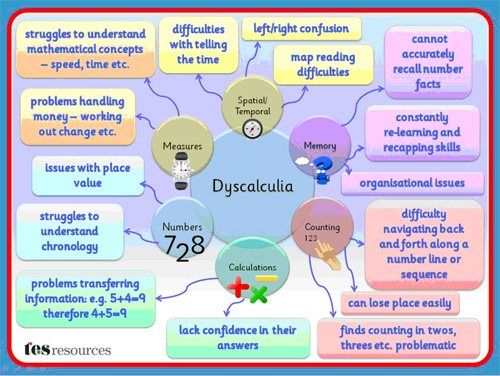
​Dyscalculia affects an individual’s ability to comprehend numbers and to grasp mathematical concepts such as place value, negative and positive values, and fractions. Individuals with Dyscalculia also struggle to understand math facts, which makes it very difficult for them to know what techniques to apply when solving a math problem. Individuals also struggle to memorize and organize numbers and therefore have trouble with multi-step problems.
​
It is estimated that Dyscalculia affects about 3-6 percent of the population or 1 in 20 individuals. The prevalence of Dyscalculia is approaching that of Dyslexia, yet is much less studied and resourced.

5 Common Myths about Dyscalculia 
Myth: All children with Dyscalculia have the same struggles with math
Truth: Dyscalculia actually refers to a wide range of math issues, so your child’s trouble spots may be different from another child’s. For example, some kids with dyscalculia have a hard time with number concepts. Others have difficulty with the kind of visual-spatial thinking that’s needed for geometry. What most kids with dyscalculia have in common, though, is challenges remembering basic math facts and completing math problems.

Myth: Dyscalculia is math anxiety
Truth: Dyscalculia and math anxiety are not the same thing. It’s understandable that people confuse the two, though. It’s common for kids who struggle with math—like kids with dyscalculia—to become anxious about doing math homework or going to math class. Learn more about key differences between dyscalculia and math anxiety.

Myth: Dyscalculia is math Dyslexia
Truth: Although dyscalculia is sometimes referred to as “math dyslexia,” that’s just a nickname. Dyscalculia and dyslexia are separate conditions that have some overlapping symptoms. Kids dealing with both tend to have difficulty with language-based math issues, such as solving word problems and learning math vocabulary.

Myth: Dyscalculia isn't common
Truth: Dyscalculia hasn’t been studied as much as other conditions like dyslexia, but that doesn’t mean it’s uncommon. In fact, researchers are beginning to think dyscalculia may be almost as common as dyslexia.

Myth: Kids with Dyscalculia can't learn math
Truth: Kids with dyscalculia may have a harder time learning math than other kids, but that doesn’t mean they can’t learn it—and even excel at it. There are classroom accommodations your child’s teacher can use, as well as strategies and apps you can try at home to make learning math easier...and even fun! Certain types of assistive technology can make learning math a more positive and successful experience for your child.
What Causes Dyscalculia?
  • There is not a large amount of conclusive research on Dyscalculia’s causes.
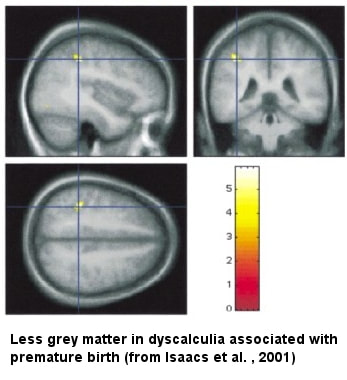
  • There is a difference in function and structure in the intra-parietal sulcus, which is the part of the brain involved in mathematics. 
  •  Both genetic and environmental factors can explain can this aberration.
  • A  link has been identified  between Dyscalculia and Fetal Alcohol Syndrome and/or premature births.
  • It is also important to note that it is common for children with Dyscalculia to additionally struggle with other learning disabilities such as Dyslexia and ADHD.
Picture
Picture
Detecting Dyscalculia
It can be difficult to detect Dyscalculia as it can be sometimes mistaken for math anxiety. Below are examples of a checklist provided by Understood.org to help parents identify signs of Dyscalculia in their child. In order to officially diagnose an individual with Dyscalculia, the child will need to be evaluated by a professional.
Preschool Signs:
  • Trouble with counting - skips over numbers long after other children count numbers in the right order
  • Struggles to recognize patterns, like smallest to largest
  • Has trouble understanding number symbols, like making the connection between “7” and seven

Grade School Signs:
  • Has difficulty learning and recalling basic math facts, such as 2 + 4 = 6.
  • Still uses fingers to count instead of using more advanced strategies (like mental math).
  • Has a tough time understanding math phrases, like greater than and less than
Picture

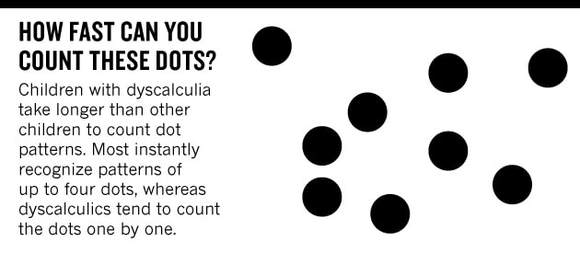
Subitizing
The ability to see a small amount of objects and know how many there are without counting.


Students with Dyscalculia would potentially have a lot of trouble with subitizing.

What Can You Do?: Classroom and At Home Management
Dyscalculia is not a disability that can be treated medically. It can however, be successfully managed with the correct amount and type of therapy and intervention. Outlined below are examples of methods that were consistently recommended.
As a parent
  • Introduce your child to math games that will require problem solving and strategy. Begin with a game your child is comfortable with and then move towards more challenging games
  • Use math in everyday activities
  • Imaginative play that requires them to handle money and make change
  • Ask them to help you cook and work with the on fractions/measurements of the ingredients
  • On trips ask your child to help you calculate distance
  • Math Geek Mama offers great resources for children with Dyscalculia
  • Visit Understood.org for 
As a teacher
  • Let the student solve the problem out loud
  • Have the student use graph paper to help organize his answers
  • Consistently check in to see if the student grasps the material
  • Review prior lessons before introducing new material
  • Create separate homework worksheets
  • Make math fun with games and colors
  • Allow extra time on tests
  • Allow students to use a calculator
  • Use written instruction rather than verbal instruction
  • If possible, work with the student 1-on-1
  • Implement a multi-sensory approach
  • Teach information in small parts. Immediately provide students with opportunities to practice that concept\
Picture
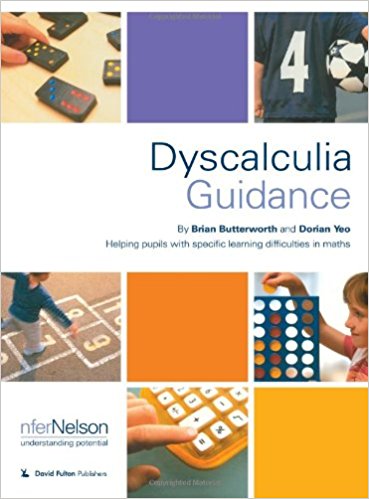
​Dyscalculia Guidance
By Brian Butterworth and Dorian Yeo
​

Dyscalculia Guidance is an accessible and practical manual for teachers to help them best support pupils with dyscalculia. It offers:
  • A detailed definition and description of dyscalculia, to aid understanding of the condition
  • Guidelines for helping dyscalculic pupils
  • Teaching strategies to help…


To purchase this text click here
Proudly powered by Weebly