Asperger's Syndrome:
Welcome! click the play button below to listen to an introduction of the site.
Through out this site you will learn and be provided many links about Asperger's Syndrome. What is Asperger's and how does it affect learning. what types of strategies can teachers use to support students and how can parents take part.
Through out this site you will learn and be provided many links about Asperger's Syndrome. What is Asperger's and how does it affect learning. what types of strategies can teachers use to support students and how can parents take part.

Have you ever wondered?
What is Asperger's Syndrome?
What are the Symptoms?
Affects on interacting with peers?
Statistics
Strategies in the classroom?
Resources
What is Asperger's Syndrome?
Asperger's Syndrome also known as ASD is a developmental disability which is a mild form of autism that is more social and behavioral but they do not have significant delays in language and cognitive development. People diagnosed with Aspergers generally have average or above average intelligence. They do however have poor social skills, lack nonverbal communication, and tend to be more clumsy. They have very strong cognitive speech and language skills that help them continue their education in passionate areas of study. many theories are being done to prove how Aspergers develops but have not been proven, however there are many studies being done to determine the cause and treatment click on button below to learn more.
|
|
Autism spectrum Disorder changes to the DSM-5:
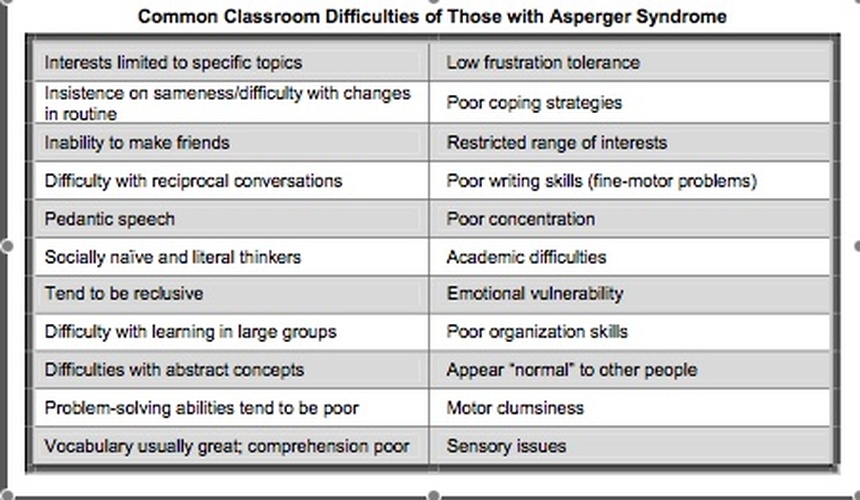
Symptoms of Asperger's Syndrome that effects learning and socialization with peers:
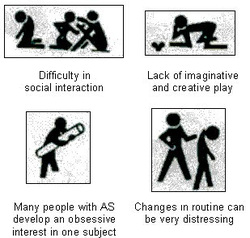
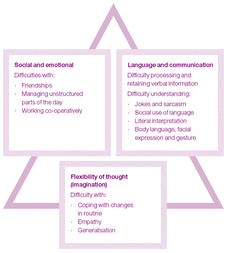
1. Failure to Develop Friendships Children who have Asperger’s syndrome may have difficulty cultivating friendships. They may not connect with their peers due to a lack of social skills. They may find it hard to talk to other children or to participate in group activities. This can be difficult for a child with Asperger’s as they may want very deeply to connect with their peers. Oppositely, some children with Asperger’s have no desire to make friendships and will prefer to be by themselves.
2. Selective MutismYoung children with Asperger’s may demonstrate selective mutism as a symptom. This occurs when they will only speak freely with people they are comfortable with, and may not speak at all to strangers. Extreme cases last for years. Immediate family members are typically unaffected, as the child often feels comfortable speaking to them. Selective mutism more often
at school and in public and some children may refuse to speak to anyone starting from a very young age. This condition can go away on its own, or your child may benefit from therapy.
3. Inability to Empathize Individuals with Asperger’s syndrome may find difficulty empathizing with others. As they age, the affected person will learn the accepted social response for interacting with others. While they may react appropriately and say the “right” things, they may not understand why the other person is truly upset. This can be an issue in childhood as the individual with Asperger’s may play too roughly with their peers or say harsh things, unknowingly hurting the other person. When confronted for this behaviour, the child may respond that what they said was true and that they do not understand the issue.
4. Unable to Make Eye Contact or Forcing Eye ContactPeople who suffer from Asperger’s syndrome may find it difficult to make and hold eye contact with people they are speaking to. Some believe this condition is brought about from a lack of confidence. Others recount how making eye contact can make them very uncomfortable, almost painful. There is also the theory that people with Asperger’s syndrome do not realize how important eye contact is for social communication. This may lead to the opposite problem of forcing eye contact. This can make people even more uncomfortable, while the individual with Asperger’s believes they are being more approachable.
5. Social AwkwardnessThe idea that people with Asperger’s syndrome are not passionate is completely wrong. One common term professionals use to describe people who suffer from this illness is “active but odd”. They may become very socially active, forming close friendships. Others may try to surround themselves with people, making lots of close acquaintances, but no deep friendships. This can be related to how well the individual empathizes with others. People with Asperger’s syndrome may 6. Sticking to RoutineSticking to a routine can be very important for people with Asperger’s syndrome. They may become greatly distressed and anxious when their schedule changes. New situations can be frightening. A routine can help manage the anxiety of people with Asperger’s syndrome. Thankfully, much of our world runs on tight schedules. If you suspect your child may have Asperger’s syndrome, putting them on a tight schedule may be an effective way to help manage some of their symptoms.show many outward signs of this illness.
7. Narrowed InterestsIndividuals with Asperger’s syndrome may do poorly in school, but that is not to say they don’t have specific interests. Instead, their interests are likely very narrowed and focused. It could be playing video games, making models, or drawing. These activities focus their minds and provide a sense of comfort for them. If they are forced to leave their projects, they may become distressed. Likewise, if their projects are failing. Fostering these narrowed interests is important for emotional and mental support.
8. Literal InterpretationsOne of the symptoms of Asperger’s syndrome is literally interpreting what people say. The affected individual may not understand sarcasm, instead taking what the person has said as truth. The idea that people with Asperger’s syndrome do not understand humor is wrong. These individuals may be the funniest people you have ever met. When they realize the fault of their literal interpretations, they are able to understand the true meaning behind what is being said, perhaps with some explanation.
9. Excellent Pattern RecognitionAnother symptom of Asperger’s syndrome is the amazing ability to recognize patterns. Often these individuals’ brains are trying to make sense of their surroundings, so a break in pattern may show itself quite clearly. This ability may be evident in childhood, as early schooling develops the neural pathways of pattern recognition. While children with Asperger’s syndrome may find the school setting difficult and struggle with their grades, pattern problems like math and in art may be very enriching. Fostering this natural talent is a great idea.
10. Poor Motor SkillsSome people with Asperger’s syndrome may find it difficult to control their gross and fine motor skills. The motor issues may manifest through poor handwriting thought to be caused by poor hand-eye coordination.
for more information go to http://www.activebeat.co/your-health/10-symptoms-of-aspergers-syndrome/10/
2. Selective MutismYoung children with Asperger’s may demonstrate selective mutism as a symptom. This occurs when they will only speak freely with people they are comfortable with, and may not speak at all to strangers. Extreme cases last for years. Immediate family members are typically unaffected, as the child often feels comfortable speaking to them. Selective mutism more often
at school and in public and some children may refuse to speak to anyone starting from a very young age. This condition can go away on its own, or your child may benefit from therapy.
3. Inability to Empathize Individuals with Asperger’s syndrome may find difficulty empathizing with others. As they age, the affected person will learn the accepted social response for interacting with others. While they may react appropriately and say the “right” things, they may not understand why the other person is truly upset. This can be an issue in childhood as the individual with Asperger’s may play too roughly with their peers or say harsh things, unknowingly hurting the other person. When confronted for this behaviour, the child may respond that what they said was true and that they do not understand the issue.
4. Unable to Make Eye Contact or Forcing Eye ContactPeople who suffer from Asperger’s syndrome may find it difficult to make and hold eye contact with people they are speaking to. Some believe this condition is brought about from a lack of confidence. Others recount how making eye contact can make them very uncomfortable, almost painful. There is also the theory that people with Asperger’s syndrome do not realize how important eye contact is for social communication. This may lead to the opposite problem of forcing eye contact. This can make people even more uncomfortable, while the individual with Asperger’s believes they are being more approachable.
5. Social AwkwardnessThe idea that people with Asperger’s syndrome are not passionate is completely wrong. One common term professionals use to describe people who suffer from this illness is “active but odd”. They may become very socially active, forming close friendships. Others may try to surround themselves with people, making lots of close acquaintances, but no deep friendships. This can be related to how well the individual empathizes with others. People with Asperger’s syndrome may 6. Sticking to RoutineSticking to a routine can be very important for people with Asperger’s syndrome. They may become greatly distressed and anxious when their schedule changes. New situations can be frightening. A routine can help manage the anxiety of people with Asperger’s syndrome. Thankfully, much of our world runs on tight schedules. If you suspect your child may have Asperger’s syndrome, putting them on a tight schedule may be an effective way to help manage some of their symptoms.show many outward signs of this illness.
7. Narrowed InterestsIndividuals with Asperger’s syndrome may do poorly in school, but that is not to say they don’t have specific interests. Instead, their interests are likely very narrowed and focused. It could be playing video games, making models, or drawing. These activities focus their minds and provide a sense of comfort for them. If they are forced to leave their projects, they may become distressed. Likewise, if their projects are failing. Fostering these narrowed interests is important for emotional and mental support.
8. Literal InterpretationsOne of the symptoms of Asperger’s syndrome is literally interpreting what people say. The affected individual may not understand sarcasm, instead taking what the person has said as truth. The idea that people with Asperger’s syndrome do not understand humor is wrong. These individuals may be the funniest people you have ever met. When they realize the fault of their literal interpretations, they are able to understand the true meaning behind what is being said, perhaps with some explanation.
9. Excellent Pattern RecognitionAnother symptom of Asperger’s syndrome is the amazing ability to recognize patterns. Often these individuals’ brains are trying to make sense of their surroundings, so a break in pattern may show itself quite clearly. This ability may be evident in childhood, as early schooling develops the neural pathways of pattern recognition. While children with Asperger’s syndrome may find the school setting difficult and struggle with their grades, pattern problems like math and in art may be very enriching. Fostering this natural talent is a great idea.
10. Poor Motor SkillsSome people with Asperger’s syndrome may find it difficult to control their gross and fine motor skills. The motor issues may manifest through poor handwriting thought to be caused by poor hand-eye coordination.
for more information go to http://www.activebeat.co/your-health/10-symptoms-of-aspergers-syndrome/10/
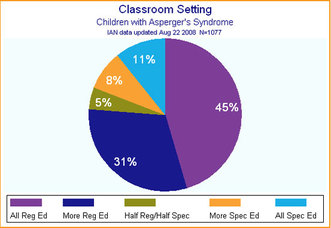
Statistics:
|
|
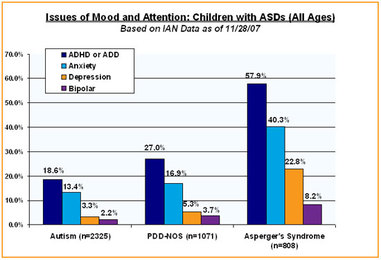
Attention Deficit Disorder (ADD), Anxiety, Depression, or Bipolar Disorder (which used to be known as "manic-depression.") Scientists want to understand how such additional diagnoses vary according to type of Autism Spectrum Disorder.
|
Intervention for Asperger's syndrome |
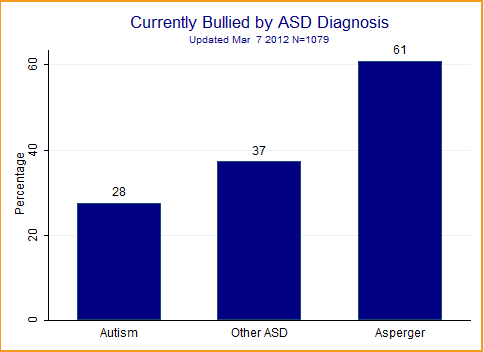
Pie chart showing children with ASD who are bullied, are bully-victims, only bully others, or have no involvement in bullying
|
Strategies resources for the classroom:
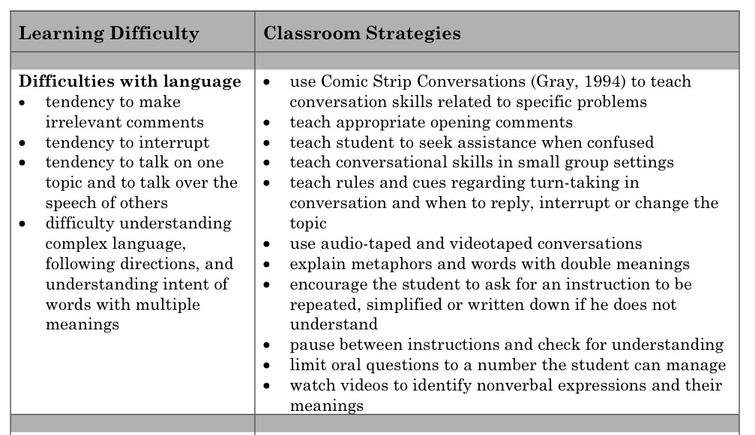
http://aspergerspresentation.wikispaces.com/Implications+for+Teaching+and+Learning this website is good for teachers to help guide them to make regular class routines and smooth transitions to help students with Asperger's syndrome. it offers great detail about what to focus on in the classroom to create a comfortable learning place for all.
http://aspergerspresentation.wikispaces.com/Instructional+Strategies this website on strategies used within a classroom is very helpful in collecting data on what to focus on to help guide a child with Asperger's Syndrome. http://www.aspieinfo.com/page20.html this article is a list of modifications that could be used to help a child with AS be successful within a classroom but it depends on the individual child not everyone is alike. http://www.schoolbehavior.com/disorders/aspergers-nld/classroom-tips-for-students-with-asperger%E2%80%99s-disorder/ an article for the teacher to understand how to keep routine and structure in the classroom. http://www.healthcentral.com/autism/c/1443/156580/accommodate-autism/ Article on accommodation in an inclusion classroom for teachers. http://www.aane.org/about_asperger_syndrome/asperger_syndrome_interventions_children.html this article talks about the different interventions used for Asperger's it will change as the child ages
|
|
Research Sources:http://www.ncab.org.au/aspergersbullying/ this research article explores how to protect a child from bullying and what are different types of autism.
http://www.yourlittleprofessor.com/bullying-and-asperger-syndrome/ this research blog is a great site for parents to understand Asperger's syndrome. it talks about many strategies and advocating for their child. http://www.autismspeaks.org/science/science-news/study-supports-view-asperger-syndrome-distinct-form-autism this research article is a great view to understanding why Asperger's is a mild form of autism and how their brain waves are similar. http://www.researchautism.org/educators/aspergersteps/index.asp this research blog allows a classroom to be set up to help the child learn successfully. |
|