Impact of Special Needs
  • BLOG 2017
  • IMPACT
    • History of Special Education Christina Pressley
    • INQUIRY >
      • RESEARCH AVENUES >
        • Marshall Memo
    • SYLLABUS >
      • Norms
      • Council for Exceptional Children
      • Flight Practice
      • Ladder of Feedback
      • Marshmallow Challenge
      • MeMoves!
      • National Teaching Norms
      • Scavenger Hunt
      • Unthinkables
  • FOUNDATIONS
    • Common Core >
      • Mathematics >
        • Math Graphic Organizers
        • Math: Subitizing and Ten Frames
        • Math Inclusion Resources and Strategies
      • Literacy >
        • Alphabet Awareness
        • Classroom Labels
        • Close Reading Strategies
        • The Daily Five
        • Dialogic and Guided Reading
        • Phonics Instruction
        • Phonological Awareness
        • Story Grammar Markers
        • Writing
      • TECHNOLOGY RESOURCES FOR LEARNING >
        • ACCESSIBLE INSTRUCTIONAL MATERIALS
        • Assistive Technology >
          • Assistive Technology Andrew
        • The Flipped Classroom in SPED
        • Science >
          • STEM
        • WEBSITES FOR LEARNING >
          • Web 2.0
          • cool tools
    • IEP >
      • Assessment
      • Terminology
      • Accommodations >
        • Assistive Technology >
          • Technology
          • AIM
        • MCAS Accommodations
      • Documents
      • Goals and Objectives
      • Transition Services >
        • Early Childhood Transition
      • Early Intervention
      • 504 Plans
    • INCLUSION >
      • Child Study Teams >
        • CST Report (Action Plans)
      • DCAP
      • RTI >
        • RTI in SLD Determination Lauren A
        • MA Tiered System of Supports
      • Observations
      • PALS: PEER ASSISTED LEARNING STRATEGIES
      • Para Educator
    • DISABILITY AWARENESS >
      • IRIS Resources STAR Legacy Modules
    • EDUCATIONAL STANDARDS >
      • 21st Century Skills
      • Common Core
      • IDEA >
        • Dear Colleague
        • ADA Americans with Disability Act
      • Special Education History >
        • Timelines in Special Education
    • FAMILY >
      • DIVERSITY
      • ADA and ADULTHOOD
      • Stigma in Special Needs in Latino Family Emily Burdick
  • TOPICS
    • Transgender Youth
  • LEARNING THEORIES
    • LEARNING THEORIES A-G >
      • ABA Jenna
      • All Kinds of Minds
      • Bloom's Taxonomy
      • Behaviorism
      • Bronfenbrenner’s Theory
      • Child Development
      • Cognitivism
      • Constructivism
      • GRIT
      • Growth Mindset
    • LEARNING THEORIES H-Z >
      • Kinesthetic Learning Eilish Reynolds
      • Learning Styles
      • Meaning Making
      • Motivation
      • Neuroscience
      • Building Relationships Katherine Bonilla
      • Social Learning Theory
      • Teaching for Understanding
      • Thinking Maps
      • UDL >
        • Assistive Technolog Jacqueline
        • UDL and the Common Core
        • UDL-Jenny/Lauren
      • Visible Thinking
  • DISABILITIES
    • AUTISM (ASD) >
      • Autism >
        • Autism Family Info Lindsey Blackman
        • Pink on the Spectrum Sara Cane
        • Autism Troy Sargent >
          • Autism and ABA Haley Award
          • Autism Janine Steinhauser
          • Autism James McDonough
        • Autism Rebecca Siegel
        • Autism and Language
        • Autism Kat
        • Autism and Adulthood
        • Autism in an Inclusive Classroom Kathryn N
        • Autism Dana Moody
        • Autism Non-Verbal Justin
      • ASD Resources
      • Autism-Nicky >
        • ABA in Autism Intervention Lauren C
      • Asperger's Syndrome Leeanne
    • COMMUNICATION >
      • Apraxia Victoria >
        • Apraxia Gabrielle D'Avolio
      • Communication Resources >
        • Expressive Language-Chelsey
      • Select Mutism
    • DEVELOPMENTAL DELAY >
      • Fine and Gross Motor Devel.-Denise >
        • Motor Articles
    • EMOTIONAL (BEHAVIOR) >
      • Bipolar Disorder Cailey >
        • Bipolar Disorder Caitlin Worthen
      • Behavior Resources
      • Mental Health Needs in College Peter Rakes
      • Relational Aggression Meghan Lederhos
      • Emotional Apps Katherine Bonilla
      • Trauma Supportive Practice Samantha Sinotte
    • HEALTH >
      • Cancer
      • ADHD and ADD >
        • ADHD Isabella Delmoral
        • ADHD Julia
        • ADHD Olivia Pizzi
        • ADD/ADHD >
          • ADHD Jenny/Lauren
          • ADHD Sarah Morgenthaler
      • Health Resources
    • INTELLECTUAL >
      • Acquired Brain Injury >
        • Intellectual Resources
      • Down Syndrome
      • Down Syndrome Jennifer Whitman
      • Prader-Willi Syndrome Samantha Curtis
    • NEUROLOGICAL >
      • Brain Development-Kate
      • Memory-Sarita
      • EXECUTIVE FUNTIONING >
        • Executive Functioning Disorder Laura Brady
      • Rett Syndrom Brycelyn
      • SENSORY PROCESSING DYSREGULATION >
        • SI Resources >
          • Sensory Integration-Steph >
            • SI Reference Articles
      • Fetal Alcohol Syndrome-Mary >
        • Fetal Alcohol Syndrome Elizabeth Watts
    • PHYSICAL >
      • Hearing Disability Rachel Jones
      • Physical Resources
      • Student Integration After Hospitalization Kathryn R
    • SENSORY >
      • HEARING >
        • Hearing Loss Yan Li Xu
        • Hearing Impairment Brianne Syring
        • Hearing Resources
        • Deaf and Hard of Hearing Brianna Normile
      • Sensory Processing Disorder Mikaela Newell
      • VISION >
        • Vision Resources
    • SPECIFIC LEARNING >
      • SLD Elizabeth Mossop
      • NVLD Nicole Snyder
      • LD Resources >
        • Dyscalculia Lily Chase-Lubitz
        • Dysgraphia Erin Bruce
        • Reading >
          • Dyslexia-Anthony >
            • Dyslexia Lily Montagna
            • Dyslexia Victoria Small
            • Dyslexia 2 Tiffany
            • Dyslexia Meghan
            • Dyslexia Colleen Talbot
          • Early Literacy Resources
          • LD and IDEA Issue
          • Reading by the Rules
        • Content
        • Math
        • Writing
        • Technology >
          • Reading Comprehension Strategies Meredith Chen
        • Teaching
    • TWICE EXCEPTIONAL >
      • Twice Exceptional Articles
      • Twice Exceptional Students Kelcy West
      • Twice Exceptional-Melissa
  • BEHAVIOR
    • CLASSROOM MANAGEMENT >
      • A-J >
        • 21st Century Learning
        • Behavior Modification >
          • Behavior Management Jon Weinberger
        • Bloom's Taxonomy
        • Circle of Friends
        • Collaborative Problem Solving
        • Culturally Responsive Pedagogy
        • The Daily Five
        • Differentiated Instruction
      • K-Z >
        • Kids and War
        • MeMoves!
        • Responsive Classroom
        • Socia Skills Curriculums Jessica Fox
        • Social & Emotional Learning Carol Yourman
        • Social Thinking
        • Strategies for Aggression-Jim
        • Universal Design for Learning
    • PREVENTING BULLYING >
      • Good Play Project
  • PROJECTS 2018
    • INQUIRY >
      • A-K
      • L-Z

Sensory Processing Disorder
and
Sensory Integration Strategies for the Classroom


What is Sensory Processing Disorder?
Sensory Processing Disorder is a condition that exists when sensory signals do not get organized into appropriate responses. 
Occupational therapist and neuroscientist A. Jean Ayres, PhD, likened SPD to a neurological "traffic jam" that prevents certain parts of the brain from receiving the information needed to interpret sensory information correctly. A student with SPD finds it difficult to process and act upon information received through the senses, which creates challenges in performing countless everyday tasks.They may experience motor clumsiness, behavioral problems, anxiety, depression, and school failure.
Source: SPD Foundation


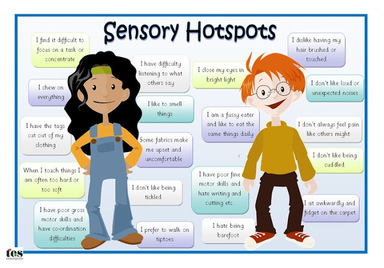
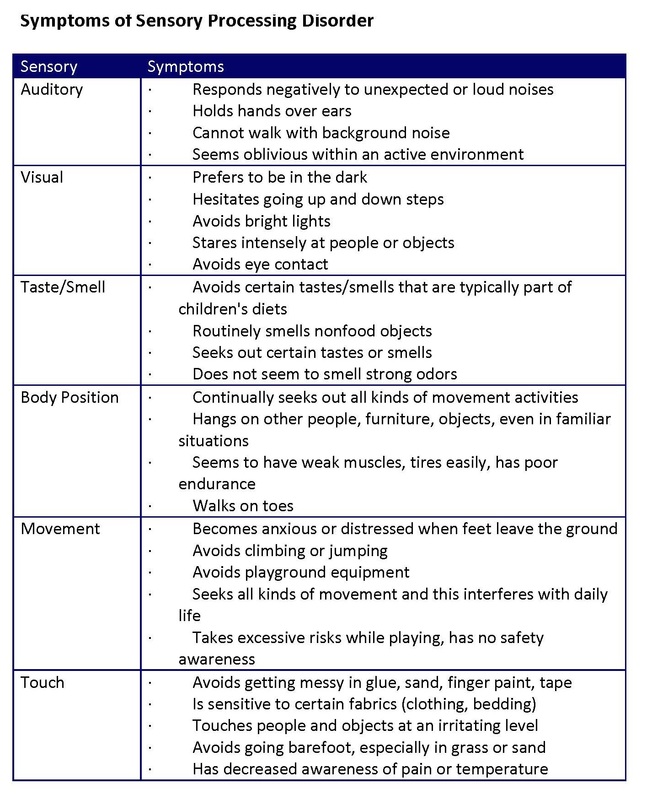
Read more about the symptoms here: SPD Foundation Sensory Processing Disorder Checklist
Picture
Picture

Experiencing SPD


Self Regulation and Education


Strategies for Supporting Students with SPD

 The Alert Program
The Alert Program


WHAT’S ALL THIS TALK ABOUT ENGINES?
Have you heard children talking about their “engines” going up into high gear (hyper) or into low gear (lethargic) or in a “just right” gear (attentive and focused)? If you haven’t yet, you probably will soon. We’re introducing the “How Does Your Engine Run?”® The Alert Program® for Self-Regulation developed by two internationally known occupational therapists, Mary Sue Williams and Sherry Shellenberger. By using the engine analogy to teach self-regulation (changing how alert we feel), we are helping children learn what to do if they are in a non-optimal state of alertness. We teach children that there are five ways to change how alert we feel: put something in the mouth, move, touch, look, or listen. We all self-regulate throughout our day, but rarely do any of us talk about it. For example, think about what you did for your engine this morning to get up and get going. To start your day, did you drink a hot cup of coffee or drink a cold fruit smoothie (mouth category)? Before work, did you go for a jog or walk the dog (move category)? To wake up, did you take a steamy hot shower or pet your cat (touch category)? Did you watch TV (look category) or turn on the radio (listen category)? We teach children how to expand the use of these types of engine strategies at school and at home to be in an optimal state for learning, playing, or interacting with their friends, family, and peers. We empower children to know what to do if their engines are in low gear and need to focus on learning a new math skill or, if their engines are in high gear, what they can do to get ready to sleep at night. You can help teach self-regulation by talking about your own engine. If your engine is in a low speed when you are trying to read a book, or if it goes up into a high speed when rushing to get to an appointment, share that with children. Don’t be surprised if children who are learning about the Alert Program®concepts suggest an engine strategy such as taking a deep breath (mouth category), stretching (move category), squeezing a stress ball (touch category), watching the sunset (look category), or listening to music (listen category). Encourage the use of engine strategies to support self-regulation so your engine and your children’s engines can run just right!
To read more about the Alert Program®, go to www.AlertProgram.com. ©2007 TherapyWorks, Inc.
Reprinted with permission for educational purposes
Yoga
View the whole article from yogachicago.com
The following is an excerpt from Mira Binzen's article, "Sensory Integration and how yoga helps".

How Yoga Helps
Relaxation response . The sensory system is soothed, and the relaxation response (parasympathetic dominance) is engaged in forward folds; deep, even breathing; progressive relaxation (tensing then releasing each muscle group); and deep relaxation. Most children in my classes also love to put sandbags on their bodies for final rest. This is especially helpful for a child with sensory processing challenges. An eight-year-old boy in my class, whose mom signed him up to address "sensory issues," let out a series of five or six "Ahhhs" when I placed a sand bag on his chest. (Make sure the sandbags are not too heavy; check in with the child and look for easy, relaxed breathing. Leave them on for five minutes or less.) He had been irritable and very talkative during class. After relaxation, his face was soft, he smiled gently, and when I asked him how he was feeling, instead of launching into a dramatic high-energy story, as is his tendency, he just nodded his head as his smile widened. Backsen describes this as DTP, deep touch pressure. "This is the most calming form of input." It also increases body awareness, as there is increased sensory input across large surface areas of the body. Children with SPD often have weighted blankets to help them sleep at night.
Body/spatial awareness . Better body awareness is one of the greatest benefits of the yoga practice. Children get excellent proprioceptive and vestibular input through partner poses, walking around like bears and dogs (hands and feet on the floor), and in twisting poses that compress the muscles. The repetitive and soothing motions of vinyasa flow can be helpful for a child who feels too much sensory input but difficult for a child who has trouble processing proprioceptive or vestibular input.
Standing and balancing poses help develop stability, strength, and coordination. Poses such as tree, eagle, and dancer provide much needed joint compression. Moving from backbends to forward bends to twists gives the vestibular system rich input, which helps a child feel calm and grounded. This all makes it easier for children to feel more comfortable and present in their body.
Breath awareness . Breathing, mantra, mudra, and meditation all have a soothing and regulatory effect on the nervous system. Sharon Heller, PhD is a developmental psychologist who describes herself as "sensory defensive." In her book Too Loud, Too Bright, Too Fast, Too Tight: What to Do If You Are Sensory Defensive in an Overstimulating World , she shares many strategies for coping and states, "The potential of yogic breath control to revitalize the nervous system is enormous." She recommends ujjayi breathing and alternate nostril breathing. Breathing practices we teach children, including balloon breath, flower hands breath, and open wings also help soothe and balance the whole nervous system while facilitating the relaxation response. (See " Yoga for Kids; Let the Body Breathe" at yogachicago.com/may07/yogaforkids for an explanation of these breathing exercises.)
Self-awareness . All of the practices in yoga have as an aim to develop better awareness--awareness of the body, the mind, and the breath. Yoga also inherently helps develop a greater sense of self, a feeling of more ease in the world, and a sense that "everything is okay just as it is."

Articles

meeting_the_sensory_needs_of_young_children-1.pdf
File Size: 7359 kb
File Type: pdf
Download File

supporting_children_to_participate_successfully_in.2.pdf
File Size: 241 kb
File Type: pdf
Download File

sensory_integration_therapies.pdf
File Size: 695 kb
File Type: pdf
Download File


Sensory Diet
Information gathered from sensorysmarts.com

Just as a child needs food throughout the course of the day, his need for sensory input must also be met. A “sensory diet” (coined by OT Patricia Wilbarger) is a carefully designed, personalized activity plan that provides the sensory input a person needs to stay focused and organized throughout the day.

Using this sensory checklist will help you to better select the activities that will be appropriate and beneficial for your student.

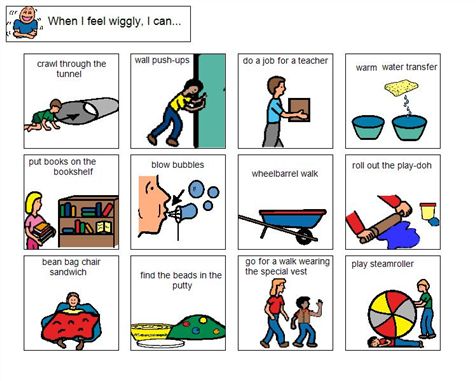
Here are some sensory diet activities for children:
Your browser does not support viewing this document. Click here to download the document.
Picture
This is an example of a menu that students could use to select an activity when their bodies need for a sensory break.

Research Articles

feelings_handout.pdf
File Size: 369 kb
File Type: pdf
Download File

the_impact_of_sensory_processing_abilities_on_the_daily_lives_of_children.pdf
File Size: 76 kb
File Type: pdf
Download File

Proudly powered by Weebly